
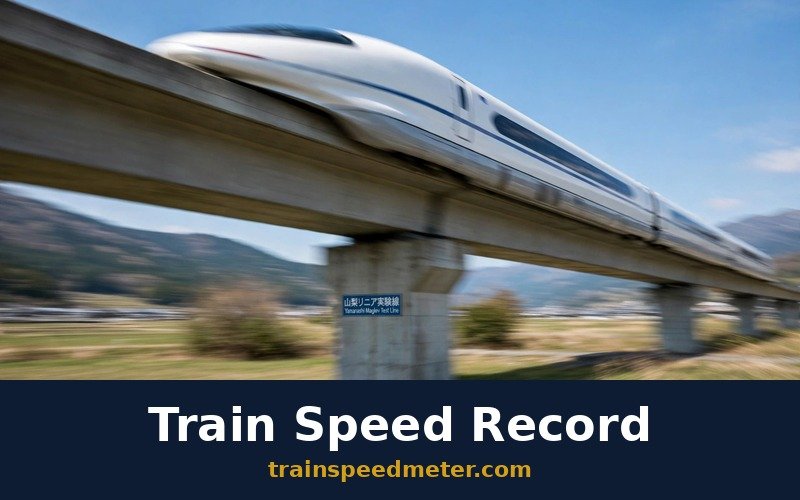
The train speed record is 603 km/h (375 mph), set by Japan’s L0 Series maglev on April 21, 2015. The record for a conventional steel-wheel train is 574.8 km/h, set by France’s TGV on April 3, 2007. In India, the fastest train in regular service, including Vande Bharat and the Gatimaan Express, is certified for 160 km/h on select sections, while most express trains stay at 130 km/h.
What Is the Train Speed Record Today?
Two numbers matter, and people often mix them up.
The absolute record is 603 km/h. Japan’s seven-car L0 Series maglev reached it on the Yamanashi Test Track with people on board. Guinness World Records lists it as the fastest maglev train, and the figure beat the same train’s 590 km/h run from five days earlier. A maglev floats on a magnetic field and has no wheel touching the rail, which is why it can go so much faster.
The steel-wheel record is 574.8 km/h. A specially tuned TGV POS set, number 4402, hit it on the LGV Est line in France. The test, code-named V150, used a modified train, a higher line voltage, and larger wheels. It was a test, not a timetable service.
Neither train carries ordinary passengers at those speeds. That is the line between a record (the fastest a train has ever gone under test) and operating speed (the fastest it is allowed to run with passengers). Most of this guide is about knowing which one a headline is talking about.
World Record Train Speed: The Full Leaderboard
Here are the milestones that matter, based on the list of rail speed records maintained on Wikipedia and Guinness World Records.
| Rank | Speed | Train | Country | Year | Type |
| 1 | 603 km/h | L0 Series | Japan | 2015 | Maglev test |
| 2 | 581 km/h | MLX01 | Japan | 2003 | Maglev test |
| 3 | 574.8 km/h | TGV POS 4402 | France | 2007 | Steel wheel test |
| 4 | 515.3 km/h | TGV Atlantique 325 | France | 1990 | Steel wheel test |
| 5 | 501 km/h | Transrapid SMT | China | 2003 | Maglev test run |
| 6 | 486.1 km/h | CRH380AL | China | 2010 | Production-type test |
| 7 | 453 km/h | CR400AF-J-0002 | China | 2023 | Prototype test |
| 8 | 443 km/h | Class 955 (300X) | Japan | 1996 | Prototype test |
A few details are worth knowing. China’s CRH380AL ran at 486.1 km/h on the Beijing–Shanghai line in December 2010, and that run is still the benchmark for how fast a nearly standard production design can go. The TGV’s 1990 record of 515.3 km/h stood as the steel-wheel mark for 17 years. And the Shanghai Maglev holds a different title: the world’s fastest commercial service, with a top operating speed of 431 km/h on its 30 km airport line.
The 800 km/h headline, explained
In late 2025, a team at the East Lake (Donghu) Laboratory in China’s Hubei province accelerated a 1.1-tonne maglev model from standstill to 800 km/h in 5.3 seconds. It then stopped within roughly 200 metres. The run took place on a track only one kilometre long.
That is an impressive acceleration test, but it is not a passenger train, and it does not replace the 603 km/h record, which was set with a full seven-car train carrying people. Treat it as proof of propulsion and braking technology rather than a new answer to “how fast can a train go.”
Fastest Trains You Can Actually Ride
Records are fun. Most readers also want to know what they can ride. Operating speeds are lower because a train that runs every day has to be safe, quiet, and affordable to maintain.
| Service | Top operating speed | Country | Note |
| Shanghai Maglev | 431 km/h | China | 30 km airport link, about 7 minutes |
| CR400 Fuxing | 350 km/h | China | Beijing–Shanghai corridor |
| TGV Duplex / INOUI | 320 km/h | France | LGV Est, LGV Méditerranée |
| E5 Series Shinkansen | 320 km/h | Japan | Tohoku Shinkansen (“Hayabusa”) |
| Al Boraq | 320 km/h | Morocco | Tangier–Kenitra, first high-speed line in Africa |
| ICE 3 | 300–320 km/h | Germany | Higher speed when running in France |
| Eurostar e320 | 320 km/h | UK / France | London–Paris |
| Vande Bharat (India) | 160 km/h permitted | India | Only on certified sections |
Speed on paper is half the story. The more useful number for a traveller is average speed, the whole journey divided by the whole time. On that measure, China’s Beijing–Nanjing run on the Beijing–Shanghai line leads: about 1,022 km in 193 minutes, which works out to 317.7 km/h. That is faster than many flights feel door to door.
Fastest Train in India: What the Numbers Really Say
This is where most online articles go wrong. They quote a single number and move on. In reality, India has three separate speeds for its fastest trains.
Design or trial speed. The first Vande Bharat set (originally Train 18) reached 180 km/h during trials. It was designed to go faster than anything the track could handle.
Permitted speed. The Tughlakabad–Agra section near Delhi is cleared for 160 km/h. Vande Bharat and the Gatimaan Express are the two services that can use it. Wikipedia’s Vande Bharat page notes that 160 km/h is the highest operational speed on the Indian Railways network.
Real running speed. On most routes, Vande Bharat tops out at 130 km/h, and the average over a full journey is far lower. A former railway officer involved in its development said publicly in 2026 that the train has never exceeded 130 km/h on most sections, and that the existing track supports a maximum of about 130 km/h in many places.
So the honest answer to “what is the fastest train in India?” is: Vande Bharat and Gatimaan Express share the title at 160 km/h on the Delhi–Agra stretch, and Vande Bharat is the fastest train overall by design. Everything else, Rajdhani, Shatabdi and Duronto included, is built for 130 km/h with a handful of sections certified higher.
Gatimaan Express speed record
Launched in 2016, the Gatimaan Express was India’s first semi-high-speed train. It covers Delhi to Agra at a top speed of 160 km/h and an average speed of around 112 km/h. In practice, the 160 km/h run lasts only for the stretch between Tughlakabad and Agra Cantt. If you want to see it for yourself, our Gatimaan speed test page shows how that section behaves on a live GPS reading.
Shatabdi speed
The Shatabdi Express earned a reputation in the late 1980s, when trials on the Delhi–Agra corridor ran at 160 km/h, and the train was certified for 140 km/h in service. Today, riders on routes such as New Delhi–Bhopal report speeds of 150–155 km/h in short bursts, though these come from phone readings and should be treated as approximate. For route-by-route behaviour, see our Shatabdi speed test.
Vande Bharat top speed
The key point about Vande Bharat top speed: it is a train capable of far more than most lines allow. Its second-generation sets are rated for 160 km/h in service. If you ride one, you will feel the difference mainly in acceleration, since it reaches 100 km/h in about 52 seconds and gets to cruising speed quickly. Our Vande Bharat speed test page lets you see what your train is doing in real time.
Why Indian Trains Don’t Run Faster
The train is rarely the limit. The track is.
High speed needs more than a strong engine. It needs straight alignment with gentle curves, fenced corridors with no level crossings, heavier rails and sleepers, and signalling that keeps trains safely spaced at speed. Indian Railways has pushed hard here: the length of track supporting 130 km/h or more has grown from about 5,000 km in 2014 to over 23,000 km in 2025, roughly one-fifth of the network.
Then there is traffic. India runs one of the world’s busiest mixed networks, with fast trains, slow passenger trains and freight sharing the same lines. A single slow train ahead can pull a 160 km/h service down to 60. That is why the average speed of Vande Bharat services has been much lower than the limit on paper.
Safety systems matter too. Kavach, India’s indigenous automatic train protection system, is meant to prevent overspeeding and signal errors, and it is part of the plan for running 160 km/h and beyond with confidence.
Pro tip: If you want to know whether a route is likely to be fast, look at the number of stops and the type of line. Double-track, electrified, fenced corridors with few halts, like Delhi–Agra, are where you will see the highest numbers.
Bullet Trains and India’s Next Step
The Mumbai–Ahmedabad high-speed rail project is India’s first bullet train line, based on Japanese Shinkansen technology. It is planned for a top operating speed of around 320 km/h on dedicated, fully separate track. That would put India in the same bracket as France, Japan and Morocco for operating speed.
Until it opens, the practical way to experience real high-speed travel is abroad, or on the 160 km/h sections at home.
The fastest bullet train speed in regular service today is 350 km/h, on China’s Fuxing trains. Japan’s Shinkansen network, which began in 1964, remains the benchmark for punctuality and safety, with E5 trains running at 320 km/h.
Maglev vs. Steel Wheel: Which Is Faster?
Maglev trains use powerful magnets to lift and push the train along a guideway. With no wheel friction and no rolling resistance, they can go faster, accelerate harder and run more quietly. The downside is cost: a maglev line needs its own purpose-built track, and it cannot connect to existing railways.
Steel-wheel trains run on conventional track. They are slower at the extreme top end, but they can use existing infrastructure, share stations and run on the same lines as other services. That flexibility is why nearly every major high-speed network in the world uses steel wheels.
In short, maglev wins the speed record, and steel wheels win the real world.
How to Check Your Train’s Speed (Step by Step)
When you are on a train, you can measure how fast it is going with just your phone.
- Turn on location. Enable GPS in your phone settings.
- Open a GPS speed tool. A browser-based tool such as our live train speedometer works without installing anything.
- Allow location permission. A one-time permission is enough.
- Give it 10 to 15 seconds. GPS needs time to lock onto satellites and settle.
- Sit near a window. Signal is stronger at the glass than in the middle of the coach.
- Compare readings over a minute. Look at the trend, not a single reading.
In practice, phone GPS is accurate to within a few km/h on open track, but it can jump in tunnels, deep cuttings and near big stations. Riders on forums regularly report readings of 140 or even 190 km/h on trains whose track limit is 130. Those are almost always GPS errors. If a figure is far above the known section limit, don’t trust it.
Who Needs to Know This? Use Cases
- Travellers comparing Vande Bharat, Gatimaan and Shatabdi before booking can see which has the highest practical speed on their route.
- Rail enthusiasts can track and log top speeds on different sections.
- Students preparing for railway exams often get questions on top speeds and records, so the permitted vs. design speed distinction is useful.
- Writers and content creators need accurate figures. The most common error is mixing up test records with operating speeds.
A Short History of the Speed Record
The first steam locomotives of the 1820s ran at walking pace. By 1934, the Flying Scotsman became the first steam locomotive to be authenticated at 100 mph. In 1938, LNER’s Mallard reached 126 mph (202.6 km/h), which remains the steam record, though a 2018 re-analysis of the original measurements suggests a sustained peak slightly lower, around 199 km/h.
Electric power changed everything. In 1955, French locomotives hit 331 km/h. The TGV took the record to 380 km/h in 1981, then 515.3 km/h in 1990, then 574.8 km/h in 2007. In parallel, Japan’s maglev work pushed the absolute figure to 603 km/h in 2015.
Common Mistakes When Reading Speed Records
- Mixing tests and timetables. A test record is not what you ride.
- Quoting design speed as running speed. Vande Bharat’s 180 km/h trial figure is not its service speed.
- Trusting a single GPS reading. Always check against the known section limit.
- Ignoring average speed. A train with a high top speed and many stops can be slower overall than a lower-speed non-stop service.
Frequently Asked Questions
What is the current train speed record?
The fastest speed ever reached by a train is 603 km/h (375 mph), set by Japan’s L0 Series maglev on April 21, 2015. For a conventional wheeled train, the train speed record is 574.8 km/h, set by France’s TGV in 2007.
What is the fastest train in India?
Vande Bharat and the Gatimaan Express are the fastest trains in India, both permitted to run at 160 km/h on the Tughlakabad–Agra section. Vande Bharat is designed for higher speeds, but on most routes it runs at 130 km/h because of track limits.
What is the Vande Bharat top speed?
Vande Bharat was tested at 180 km/h, and its second-generation sets are rated for 160 km/h in service. On most routes, the Vande Bharat top speed in daily running is 130 km/h, because the track and traffic on those lines limit what the train can do.
Which Indian train has the highest recorded speed?
In trial runs, the original Vande Bharat reached 180 km/h, the highest speed recorded for an Indian train set. In regular service, the Gatimaan Express and Vande Bharat share the top operating speed of 160 km/h, on the Delhi–Agra route.
What is the highest speed train in the world in daily service?
The Shanghai Maglev is the fastest in daily service at 431 km/h, but it runs only 30 km to the airport. For conventional intercity travel, China’s CR400 Fuxing runs at 350 km/h, which makes it the fastest regular high-speed rail service.