
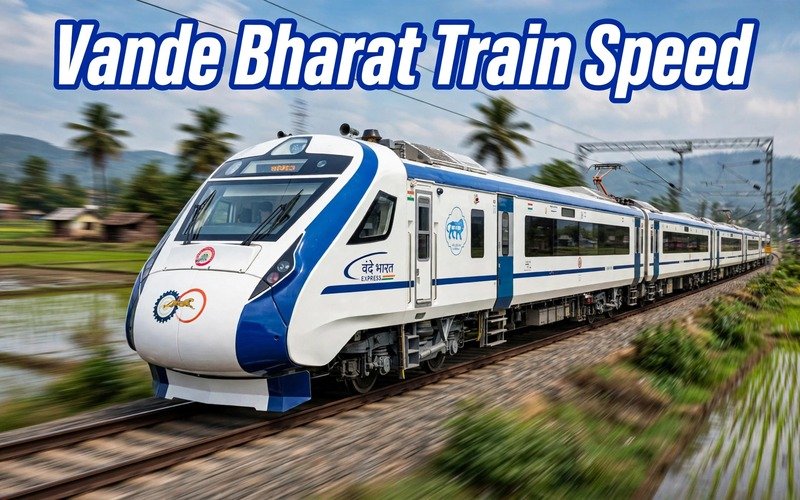
Vande Bharat train speed is capped at 160 km/h in regular service. The trainsets are designed for 180 km/h and have reached that figure in trials. The Vande Bharat Express maximum speed is therefore 160 km/h on cleared routes. The real Vande Bharat average speed is much lower, around 71 km/h across the network, because of station stops, curves and shared tracks. Speed in km/h varies by route, and the sleeper version follows the same limits.
The Four Speeds People Mix Up
Most of the confusion around Vande Bharat comes from the word “speed” meaning four different things. Mixing them up is why one website says 180 km/h, another says 160, and a third says 95.
| Type of speed | What it means | Vande Bharat figure |
| Design speed | What the trainset is engineered to handle | 180 km/h (Vande Bharat 2.0 onward) |
| Trial speed | Highest speed reached during testing | Around 180 km/h and slightly above in some trials |
| Maximum operating speed | The legal limit in passenger service | 160 km/h, only on cleared sections |
| Average scheduled speed | Distance divided by total journey time | About 71 km/h network-wide; 54 to 95 km/h by route |
For a passenger, the last row matters most. It decides when you reach your destination.
Vande Bharat Express Maximum Speed: 160 km/h on Paper, Not Everywhere
The first Vande Bharat Express began service on 15 February 2019 on the New Delhi–Varanasi corridor. According to a Ministry of Railways release published through the Press Information Bureau, the original 16-coach trainset was designed for 160 km/h. The newer Vande Bharat 2.0 trains are designed for 180 km/h with an operating speed of 160 km/h, subject to route readiness.
The phrase “subject to route readiness” explains most of what you feel on board. A train can only run as fast as the track beneath it allows. Before a section is cleared for 160 km/h, it needs strong track geometry, gentle curves, fenced boundaries, no level crossings, upgraded signalling and a sign-off from railway safety authorities. Very few sections meet all of those conditions.
The best-known 160 km/h stretch is Tughlakabad to Agra on the Delhi–Agra line. The Delhi–Agra Gatimaan Express, India’s first 160 km/h train, runs on the same section. Other corridors are cleared for lower limits, usually 110, 130 or 140 km/h, and the train slows down accordingly.
Earlier tests also helped. Pre-launch trials of the first rake in 2018 and later trials of the production trainsets recorded speeds in the 180s, so the hardware has a lot in reserve. That reserve matters for safety. A train that handles 180 km/h comfortably will brake and ride smoothly at 160 km/h.
Vande Bharat Average Speed: The Number That Decides Your Journey
If you look at timetables instead of trial reports, the picture changes. Data compiled from current schedules by Railzi shows that across the 164 Vande Bharat services running by the end of 2025, the average scheduled speed is around 71 km/h. The typical service covers about 532 km in roughly 7 hours 27 minutes with six intermediate halts.
Averages hide a wide spread:
- Fastest average: the New Delhi–Varanasi service (22435) covers 759 km in 8 hours, roughly 95 km/h. That is the best average on the network.
- Slowest average: the Gorakhpur–Patliputra service (26502) covers 384 km in 7 hours 5 minutes, about 54 km/h.
- Hill route: the Jammu Tawi–Srinagar service (26401) covers 267 km in 4 hours 50 minutes, about 55 km/h. That is a mountain alignment with tunnels, gradients, and tight curves, so a low average there is normal.
- Longest route: Howrah to Kamakhya, 968 km in 14 hours with 13 halts, about 69 km/h.
How to Work Out the Real Average Speed of Any Vande Bharat
You can check any route yourself in three steps:
- Note the route distance from the timetable (for example, 759 km).
- Note the scheduled journey time and convert it to hours (8 hours 0 minutes is 8.0).
- Divide distance by time: 759 ÷ 8 = about 95 km/h.
Count the halts on the schedule too. Each stop costs several minutes once braking; the halt and the climb back to cruising speed are included. A route with 13 halts will always average lower than one with 4, even at the same top speed.
Why Vande Bharat Rarely Touches 160 km/h
Four things hold the number down.
Shared tracks. Most Vande Bharat services run on lines also used by freight trains, local passenger trains, and slower expresses. The fastest train on a shared line is still bound by the signals behind slower trains in front of it.
Speed restrictions. Bridges, junctions, yards, curves and sections under maintenance all carry temporary or permanent limits, and the driver must respect each one.
Level crossings and fencing. Where a track is not fully fenced or has crossings, a 160 km/h limit is unsafe. Much of the network still needs this infrastructure upgraded.
Signalling. Faster trains need longer braking distances, and the signalling has to account for that. India’s indigenously developed Kavach Automatic Train Protection system, certified to Safety Integrity Level 4, monitors train movement and automatically applies brakes to prevent overspeeding and signal violations. It is part of the safety case for higher speeds, but it must be installed along the track as well as on the train.
In practice, you feel this as a pattern: the train accelerates smoothly out of a station, cruises in the 110 to 130 km/h range on most of the journey, and sees 150 to 160 km/h only on a few cleared stretches. This is normal operation, not a fault.
What Makes Vande Bharat Fast Off the Line
A big part of the Vande Bharat advantage is acceleration, not top speed. Traditional trains use a locomotive at the front pulling the coaches. Vande Bharat uses distributed traction: motors are spread under several coaches, so power is applied across the whole train.
The effect is quick acceleration and strong, controlled braking. Indian Railways figures put the 0 to 100 km/h time at about 52 seconds for the newer trainsets. The first generation was slightly slower. Vande Bharat 2.0 also cut weight from about 430 tonnes to about 392 tonnes, which helps acceleration further. Regenerative braking sends part of the braking energy back into the system, and the aerodynamic nose reduces drag at higher speeds.
This matters on routes with many stops. A locomotive-hauled train needs a long distance to get back to cruising speed after each halt. A Vande Bharat gets there much sooner, and those saved minutes add up over six or more stops. That is why Indian Railways describes journey-time reductions of up to 45 percent on several corridors, and why the New Delhi–Varanasi trip of roughly eight hours is described as 40 to 50 percent faster than earlier services.
Vande Bharat vs Shatabdi and Other Fast Trains
The Rajdhani Express (introduced 1969) and the Shatabdi Express (introduced 1988) were India’s benchmark premium trains for decades. Here is how the speeds compare.
| Train | Typical maximum speed | Typical journey feel | Notes |
| Vande Bharat Express | 160 km/h (limit); 180 km/h design | Fast acceleration, quicker braking | Self-propelled, no locomotive swap |
| Gatimaan Express | 160 km/h | Delhi–Agra in about 100 minutes | Fastest conventional train; 160 km/h on Tughlakabad–Agra |
| Shatabdi Express | Around 130 km/h; higher on a few sections | Comfortable day service | Locomotive-hauled |
| Rajdhani Express | Around 130 km/h; some sections higher | Overnight and long distance | Locomotive-hauled |
| Japan’s Tokaido Shinkansen | About 285 km/h | Dedicated high-speed track | Reference for true high-speed rail |
| Mumbai–Ahmedabad bullet train (planned) | 320 km/h design | Dedicated corridor | Under construction |
Vande Bharat’s advantage over Shatabdi is smaller at the top end than most people expect. The real gains come from acceleration, braking, and the 160 km/h clearance on selected sections. On a route where Shatabdi and Vande Bharat both run, Vande Bharat typically saves time through shorter run times between stops instead of a much higher cruising speed.
The Gatimaan Express is the closest comparison. It matches Vande Bharat at 160 km/h but remains locomotive-hauled and runs on a single corridor.
Vande Bharat Top Speed vs Bullet Train
The honest comparison is that Vande Bharat is semi-high-speed, not high-speed. International practice generally treats 250 km/h and above on dedicated track as true high-speed rail. Vande Bharat runs on existing mixed-traffic tracks at up to 160 km/h.
Japan’s Shinkansen network shows the gap: Tokaido Shinkansen trains cruise at about 285 km/h on purpose-built track with no level crossings and no freight. The planned Mumbai–Ahmedabad high-speed rail corridor is designed for 320 km/h, and its construction is staged in sections, so passengers should check current announcements for opening dates instead of relying on older estimates.
Vande Bharat’s role is different. It upgrades the speed of the existing network quickly and cheaply, while bullet train corridors need entirely new alignments. Indian Railways has also said that Vande Bharat 4.0 is being positioned for future dedicated high-speed corridors, with planned speeds of up to 350 km/h.
Vande Bharat Sleeper Train Speed
The Vande Bharat Sleeper was flagged off on 17 January 2026 between Howrah in West Bengal and Kamakhya (Guwahati) in Assam. It is a 16-coach air-conditioned rake with one AC First Class, four AC 2-Tier and eleven AC 3-Tier coaches, carrying about 823 passengers.
On speed, the sleeper trainset was tested at up to 180 km/h on the Kota–Nagda section under the supervision of the Commissioner of Railway Safety. Long-distance endurance trials by the Research Designs and Standards Organisation (RDSO) were run on the Mumbai–Ahmedabad corridor. In service, it follows the same rule as every other Vande Bharat: it runs at the limit of whatever the track allows, with 160 km/h as the ceiling on cleared sections.
The timetable tells the more useful story. The Howrah–Kamakhya service covers 968 km in about 14 hours, an average near 69 km/h. The Saraighat Express on the same corridor takes around 17 hours, so the saving is about three hours. That is a meaningful gain for an overnight journey, even though the average speed is modest.
Fastest Vande Bharat Train Route
By scheduled average speed, the New Delhi–Varanasi service sits at the top with roughly 95 km/h. Several things help it: strong track on the Delhi–Kanpur–Prayagraj stretch, limited halts for its length, and a long run at higher permitted speeds.
The fastest route by maximum speed is a different question, and the answer is the Tughlakabad–Agra section. Services that use it, including the Rani Kamalapati (Habibganj)–Hazrat Nizamuddin Vande Bharat and the Nizamuddin–Khajuraho service, can run at the full 160 km/h there.
If you plan travel around speed, look at the schedule average instead of the advertised top speed. A train advertised at 160 km/h can still average 60 km/h.
Evolution of Vande Bharat Speed by Version
| Version | Design speed | Operating speed | Notable change |
| Original (2019) | 160 km/h | Up to 160 km/h on cleared sections | First 16-coach rake, launched 15 February 2019 |
| Vande Bharat 2.0 (2022) | 180 km/h | 160 km/h | Lighter, about 392 tonnes; Kavach provision; improved regenerative braking |
| Vande Bharat 3.0 | 180 km/h | 160 km/h | Smoother ride, quieter, about 52 seconds from 0 to 100 km/h |
| Sleeper (2026) | 180 km/h | Up to 160 km/h on cleared sections | Long-distance overnight service |
| Vande Bharat 4.0 (planned) | Higher benchmark | To be confirmed | Next-generation interiors and Kavach 5.0; tied to future high-speed corridors |
The pattern is clear. Vande Bharat’s design speed jumped to 180 km/h with the second version, but the operating speed has stayed at 160 km/h. The next gains will come from track upgrades, not from new trainsets.
How to Check Vande Bharat Speed Yourself
Passengers often want to check what the train is actually doing. A phone with GPS is enough.
- Open a browser-based speed checker such as the Vande Bharat speed test before departure.
- Allow location access and tap start as the train begins to move.
- Sit near a window for better satellite reception. GPS usually still works through window glass in an AC chair car.
- Watch the reading build as the train leaves the platform, then compare the peak to the route limit.
- Expect the reading to drop to zero briefly inside tunnels and recover once the train emerges.
Speeds on other trains are collected on the India train speeds page if you want to compare.
Who Benefits Most from Vande Bharat Speed
Business travellers. Time saved comes from quick acceleration and shorter total journeys on routes like New Delhi–Varanasi. For a same-day return trip, the difference between 8 hours and 10 hours decides whether the trip is practical.
Families and tourists. On long routes, the saving is smaller in percentage terms, but a cleaner, quieter, smoother ride matters more than raw speed on a long day.
Overnight travellers. The sleeper cuts around three hours on the Howrah–Kamakhya corridor, though the berths are a bigger draw than the speed.
Railfans and students. The corridor-by-corridor spread, from 54 km/h to 95 km/h, shows how track quality shapes a train’s real performance, and it is a good case study in infrastructure.
Limits and Honest Trade-offs
Vande Bharat is quick for what Indian infrastructure allows, but it has limits. It does not deliver a bullet train’s speed. Its average speed on many routes is not far above that of Shatabdi. Fares are generally higher than conventional trains, and delays on shared tracks affect it as they do any other train. On some routes, such as hill sections, the gain over older trains is small.
What it does offer is consistency: better acceleration, a smoother ride, modern safety systems and a growing network. Indian Railways has said it plans to scale the fleet to around 800 trainsets by 2030, subject to infrastructure readiness and manufacturing capacity.
The Bottom Line on Vande Bharat Train Speed
Vande Bharat train speed has three honest answers: 180 km/h is what the trains are built for, 160 km/h is the most they are allowed to run, and around 71 km/h is what most passengers actually experience as an average. The first number makes headlines, but the last one decides your arrival time.
When you pick a train, check the scheduled average speed, the number of halts, and the track quality of the route, not only the advertised maximum. As more sections are cleared for 160 km/h and more of the network is fenced and upgraded with Kavach, the gap between the top speed and the average speed will narrow.
Frequently Asked Questions
What is the maximum speed of the Vande Bharat Express?
The Vande Bharat Express has a maximum operating speed of 160 km/h. That limit applies only on sections cleared for it, such as Tughlakabad to Agra. Newer trainsets are designed for 180 km/h and have reached it in trials, but passenger service stays at 160 km/h or below depending on the track.
What is the average speed of a Vande Bharat train?
Across the network, the average scheduled speed is about 71 km/h. Individual routes range from roughly 54 km/h on slower, busier lines to about 95 km/h on New Delhi–Varanasi. Average speed depends on halts, curves, gradients, and how crowded the line is.
Why doesn’t Vande Bharat run at 180 km/h?
Indian tracks are not yet built for it. Most lines carry mixed traffic, have curves and level crossings, and need signalling that allows longer braking distances. Until track fencing, alignment and signalling are upgraded, the 160 km/h cap remains. The extra design capacity gives a safety margin.
Is Vande Bharat faster than Shatabdi?
Yes, though by a smaller margin than people expect. Vande Bharat can run at 160 km/h on cleared sections against roughly 130 km/h for most Shatabdi services. Most of the time saving comes from faster acceleration and braking between stops, which cuts minutes on routes with many halts.
What is the Vande Bharat sleeper train speed?
The sleeper rake was tested at 180 km/h and is designed for it. In service, it runs at the limit of each section, up to 160 km/h on cleared track. On Howrah–Kamakhya the 968 km journey takes about 14 hours, which averages close to 69 km/h.