
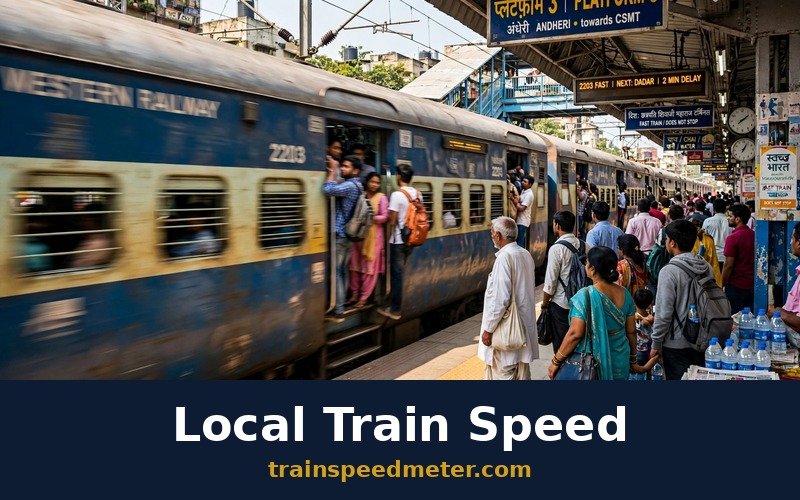
Local train speed in India usually tops out at 100–110 km/h (62–68 mph), but the average speed of a local train is much lower, around 35–50 km/h, because of frequent stops, acceleration cycles, and signal limits. The maximum speed of a local train in Mumbai is 110 km/h; Chennai’s is about 100 km/h, and Kolkata sits in the same band. Fast locals average more than slow ones, yet neither matches an express train.
What Counts as a Local Train in India
When people in Indian cities say “local”, they mean a suburban commuter service: short hops, tight gaps between trains, and a stop at nearly every station. Most of these run as electric multiple units, or EMUs, where traction motors are spread across several coaches instead of sitting in a separate locomotive. That is why a rake can reverse direction at a terminus without a locomotive being shunted to the other end, and why it picks up speed so quickly after every halt.
Two cousins are worth knowing. MEMUs (mainline electric multiple units) are sturdier rakes built for longer, less frequent runs, such as the services around Delhi NCR. DEMUs do the same job on routes with no overhead electrification. Conventional loco-hauled passenger trains also stop often, but they run at their own pace, generally somewhere between 40 and 80 km/h while moving.
Local train speed, then, depends less on the train than on the job it is asked to do. A rake built to reach 100 km/h is mostly asked to do it a kilometre or two at a time.
Local Train Speed in km/h and mph
Indian Railways quotes everything in km/h, so that is the unit you will see in timetables, station announcements and on the speed boards beside the track. International readers, and anyone comparing with UK or US networks, usually want mph. Multiply km/h by 0.62 to convert. Divide km/h by 3.6 to get metres per second, which is handy for physics homework.
| Speed measure | km/h | mph | m/s |
| Average, slow local | 35 | 22 | 9.7 |
| Average, fast local | 40–50 | 25–31 | 11–14 |
| Typical top speed, Chennai | 100 | 62 | 27.8 |
| Typical top speed, Delhi NCR EMU and MEMU | 105–110 | 65–68 | 29–31 |
| Mumbai and Kolkata maximum | 110 | 68 | 30.6 |
| Select Kolkata main-line stretches | Up to 130 | 81 | 36 |
| Namo Bharat regional rapid rail | 160 | 99 | 44 |
Average Speed of a Local Train vs Maximum Speed
These two numbers answer different questions. The maximum speed of a local train is the highest speed the rake is permitted to reach on a given section, and for most suburban EMUs that is 100–110 km/h. The average speed is the total distance divided by the total journey time, halts included, and for locals it lands between 35 and 50 km/h. The average is the one that decides when you reach the office.
The gap is easier to believe once you do the arithmetic. Take two stations 1.5 km apart. A rake accelerating at about 0.7 m/s² needs roughly 40 seconds and 550 metres to reach 100 km/h. Braking at 0.8 m/s² takes another 35 seconds and about 480 metres. That leaves under 500 metres of cruising, which lasts about 17 seconds. Add a 30-second halt and the whole hop takes around two minutes: an average of about 44 km/h for a train that touched 100 km/h. These are round, illustrative figures, but they sit in the normal range for suburban EMUs, and real-world averages come out lower once signals and crowds stretch the schedule.
What pulls the average down
- Station spacing. With stations a kilometre or two apart, a local spends most of its trip speeding up or slowing down.
- Dwell time. A planned 30-second halt becomes a minute when a peak-hour crowd is boarding and getting off.
- Signals and headways. Trains follow each other a few minutes apart. If the one ahead is slow, the one behind is slowed by a caution aspect.
- Shared tracks. Where locals share a corridor with mail and express trains, the priority traffic gets the clear run.
- Curves, points and bridges. Each carries a permanent speed restriction, and crossovers near terminals are taken slowly.
- Weather and works. Waterlogging in the monsoon and track maintenance bring temporary slowdowns.
The Gatimaan Express speed test shows a premium service touching its top speed only on select sections, with the journey average far lower.
Local Train Speed by City
The label “local” covers very different operations. This table shows how the major suburban networks compare, and the notes below it explain what sets each one apart.
| Network | Typical top speed | Average speed | What shapes it |
| Mumbai Suburban Railway | 110 km/h (68 mph) | About 35 km/h on slow lines; 40–50 km/h on fast lines | Dense stopping pattern, very short gaps between trains |
| Chennai Suburban Railway | 100 km/h (62 mph) | About 45–50 km/h | Wider station spacing on outer sections |
| Kolkata Suburban Railway | 100–110 km/h, up to 130 km/h on select stretches | Around 45 km/h | Shares main-line corridors with long-distance traffic |
| Delhi NCR EMU and MEMU | Up to 105–110 km/h (65–68 mph) | 35–45 km/h | Shared mainline tracks and MEMU stopping patterns |
| Namo Bharat (Delhi–Ghaziabad–Meerut) | 160 km/h (99 mph) | 90–100 km/h | Dedicated corridor, wider station spacing |
Mumbai: the busiest test case
Mumbai’s Western, Central and Harbour lines carry passenger volumes that Wikipedia’s overview of the Mumbai Suburban Railway counts among the busiest on any commuter network in the world. Top speed is 110 km/h, but the average tells the real story: about 35 km/h on slow lines and 40–50 km/h on fast lines. A fast Western Line service from Churchgate to Virar covers roughly 60 km in a little over an hour, which works out at close to 50 km/h. Slow services take a good deal longer.
In practice, the difference between a fast and a slow local is not how hard the train accelerates. It is how many times it has to. Skipping a handful of stations removes a handful of acceleration and braking cycles, and that is where the saved minutes come from. Monsoon waterlogging and signal failures drag both averages down.
Chennai and Kolkata
Chennai’s suburban network tops out at about 100 km/h and averages roughly 45–50 km/h, a comparatively brisk figure that owes something to wider station spacing on its outer sections. Kolkata’s suburban EMUs commonly run at 100–110 km/h, with some main-line stretches permitting up to 130 km/h, and average around 45 km/h. Both are among the oldest electrified suburban systems in the country, and both share track with long-distance trains, so a local’s pace on any given day depends on who else is on the line.
Delhi NCR: EMUs, MEMUs and Namo Bharat
Delhi’s conventional EMU and MEMU services average 35–45 km/h, with top speeds up to 105–110 km/h. Namo Bharat is the outlier. This regional rapid rail runs on a purpose-built corridor between Delhi, Ghaziabad and Meerut at up to 160 km/h and averages 90–100 km/h, more than double what an ordinary local manages. The reason is not only a faster train. Wider station spacing and a corridor with no other traffic remove the delays that hold a typical local back.
Other cities
Hyderabad’s MMTS, the Pune–Lonavala locals and smaller suburban systems follow broadly the same pattern: a top speed near 100 km/h and a much lower average set by station spacing. Exact figures vary by route and timetable, so treat any single number for these networks as a guide, not a guarantee.
Local Train vs Express Train Speed
On paper, the gap between a local and an express looks smaller than it feels. A fast local can touch 110 km/h, a mail or express train cruises at 80–110 km/h, and a Rajdhani or Shatabdi runs up to 130 km/h on most routes. What separates them is that the express does not stop every two minutes. It spends minutes at speed where the local spends seconds.
| Service | Top speed | Typical pace in service | Stops |
| Slow local (EMU) | 100–110 km/h | About 35 km/h average | Every station |
| Fast local (EMU) | 100–110 km/h | 40–50 km/h average | Selected stations |
| Mail and Express | 110–130 km/h | 80–110 km/h cruising | Major stations |
| Rajdhani and Shatabdi | Up to 130 km/h; 150–160 km/h on select sections | 70–90 km/h average | Few |
| Vande Bharat | Up to 160 km/h on select sections | Varies by route | Few |
| Metro (typical) | 80–90 km/h | Low-30s km/h average | Every station |
To see how the top of the network behaves, the live readings on the Vande Bharat Express speed test, the Shatabdi Express speed test and the Gatimaan Express speed test show what these services actually do on their fastest stretches. The 160 km/h figure applies only to select sections, and most routes allow far less.
Pro tip: When a fast local and an express both serve your route, compare stopping patterns before top speeds. Two or three fewer halts will save you more time than another 10–20 km/h of cruising speed ever could.
Local Train Speed Limit: Who Sets It and Why It Changes
There is no single local train speed limit. Indian Railways fixes a maximum permissible speed for each section of track, and the figure reflects the weakest link: rail and sleeper strength, curves, bridges, signalling, level crossings and the certified speed of the rolling stock. New or raised limits are inspected and sanctioned by the Commissioner of Railway Safety, an independent statutory authority, before trains use them.
Two ceilings apply at once, the track’s and the train’s, and the lower one wins. A suburban EMU certified for 110 km/h will not exceed it on a line that allows 130, and a rake that can do 110 km/h will still crawl through a slow crossover. On top of the permanent limits sit temporary speed restrictions for track work, waterlogging or damaged structures, which are communicated to drivers (called motormen on Mumbai’s suburban lines) in advance.
Pro tip: A local that seems to crawl for half a minute in the middle of a section is almost always obeying a restriction, not struggling. If the same spot repeats every day, it is a permanent limit such as a curve, a bridge, or a junction. If it appears for a few weeks and then vanishes, it was maintenance work.
How to Check Local Train Speed Yourself
A GPS reading from your phone is the most direct way to see what your train is doing. It does not depend on the railway, the timetable, or any on-board display, and it takes about a minute to set up.
- Open the Train Speed Meter GPS speedometer in your phone’s browser before the train departs. There is nothing to install and no train number to enter.
- Allow location access when the browser asks. A one-time permission is enough.
- Stand or sit near a window with a view of the sky, and give the signal 10–15 seconds to settle.
- Tap Start once the train pulls out, and keep the screen on.
- Read the live speed as you go and, at the end of the ride, the maximum and average for the trip.
On a local, the reading draws a sawtooth: a steep climb after each station, a short plateau near the limit, then a drop as the train brakes into the next halt. It is the quickest way to see why the average sits so far below the maximum.
Pro tips for cleaner readings
- Ignore the first few seconds. The reading wobbles until the phone locks onto enough satellites.
- Expect dropouts. Tunnels, deep cuttings, covered platforms and steel bridges make the number fall to zero or jump. It recovers once the sky is visible again.
- Know the limits of GPS. According to the US government’s own GPS performance data, smartphones are typically accurate to about five metres under open sky, and accuracy gets worse near buildings, bridges and trees.
- Stay out of the doorway. Crowded locals are no place to lean out for a better signal. A window seat or a spot beside a window does the job.
- Watch the battery. GPS drains power, so dim the screen and carry a charger on longer rides.
The timetable method
If you would rather do the maths, divide the distance between two stations by the scheduled time in hours. A stretch of 24 km scheduled at 36 minutes (0.6 hours) gives 40 km/h. Station-to-station distances appear on railway route charts and on the kilometre posts beside the track. The result is an average that includes halts, so it will always sit well below the peak on a live reading, and comparing the two shows how much of each trip is spent speeding up and slowing down.
Who Needs to Know Local Train Speed
- Daily commuters can choose between fast and slow locals on facts rather than habit. Where one ticket covers both, the decision comes down to time against crowding, and the average speed settles the first half of that.
- House-hunters and renters can estimate a realistic door-to-door commute. Using the average speed rather than the top speed gives a figure you can plan a life around.
- Students and teachers get a ready-made kinematics example. Acceleration, braking distance, and average velocity are all visible in a single ride.
- Railfans and photographers log peak speeds and compare services across the day.
- Writers and journalists can sanity-check claims such as “the fastest local in the city” against measured data.
- Planners and engineers benchmark real-world speeds against timetables to spot where signals, dwell times, or restrictions are costing minutes.
Where Local Train Speed Is Heading
Top speed is not the bottleneck. A rake that can reach 110 km/h gains little from being able to reach 130 if the next station is a kilometre away. The upgrades that move averages are different: faster acceleration and braking, shorter halts, signalling that lets trains run safely closer together, and extra lines that separate suburban traffic from long-distance trains. Namo Bharat shows what happens when most of those arrive at once: an average pace that exceeds many premium expresses, on a service that still stops every few kilometres.
The Shatabdi Express speed test shows a premium service holding a steady pace on long stretches between halts.
Local Train Speed FAQs
How fast is a local train in everyday terms?
At full stretch, a local train is as quick as a car on an open highway: 100–110 km/h. But it only holds that speed for short bursts between stations. Over a whole journey, the pace feels closer to 35–50 km/h, which is still a little quicker than a car crawling through city traffic, and far more predictable at rush hour.
What is the maximum speed of a local train in Mumbai?
The maximum speed of a local train in Mumbai is 110 km/h (68 mph), and only on stretches where the track, curves and signalling allow it. Slow locals rarely get close because stations come too quickly. Across a typical trip the average works out at roughly 35 km/h on slow lines and 40–50 km/h on fast lines.
What is the average speed of a local train in km/h and mph?
Across Indian cities, the average speed of a local train falls between 35 and 50 km/h, or about 22 to 31 mph. Slow locals sit at the bottom of that range and fast locals near the top. Because the figure includes every halt, it is a better guide to your commute time than any top speed.
Why is the local train speed limit lower than an express train’s?
A local train speed limit reflects what suburban rakes and tracks were built to do: quick starts and stops, not long cruising. Suburban EMUs are generally certified for around 100–110 km/h, and their corridors are crowded with stations, crossovers and signals that keep limits down. Express trains run longer sections with fewer stops, and the best of them use stock cleared for 130 km/h or more.
Is a local train faster than a metro?
On top speed, yes: locals are cleared for 100–110 km/h while most metros are generally limited to around 80–90 km/h. In average speed they are much closer, since both stop often. A fast local that skips stations usually wins on longer trips, while a metro wins on frequency and the number of stations it serves inside the city.