
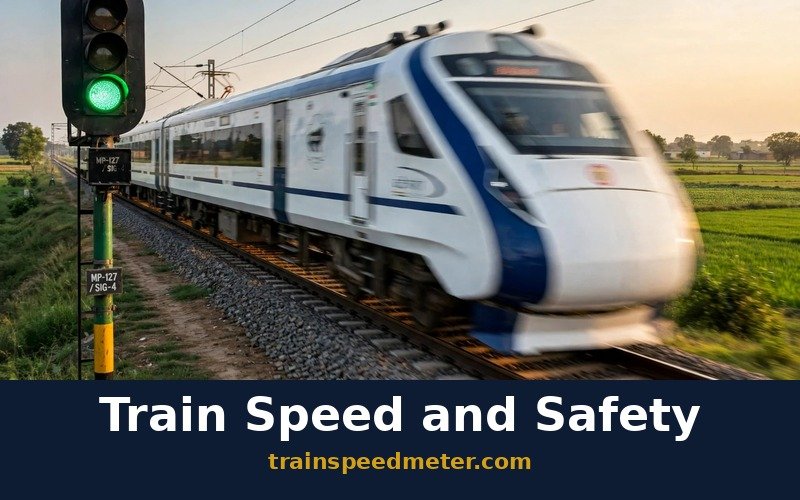
Train speed and safety come down to one rule: a train can only go as fast as its track, signals, brakes, and protection systems can handle. In India, train speed limits are fixed section by section. The maximum permissible speed of trains in India is 130 km/h on upgraded main lines and 160 km/h on a few cleared stretches. Systems such as Kavach watch speed continuously and apply the brakes automatically if a loco pilot overshoots a limit.
Why Speed Changes the Safety Equation
Speed does not raise risk in a straight line. It raises it much faster. Braking distance grows with the square of speed, so a train at 160 km/h needs about 50% more stopping distance than the same train at 130 km/h, even though it is only 23% faster.
Curves behave the same way. The sideways force on a curve and the load a passing train puts on the rails both rise with the square of speed. A technical paper from the Permanent Way Institution points out that lateral forces from all trains increase in proportion to the square of speed, which is why gauge spreading becomes more likely on lines that permit higher speeds.
Four things climb together as speed goes up: stopping distance, forces on the track, impact energy in a collision, and exposure to anything that strays onto the line, such as cattle, trespassers and vehicles at level crossings. That is why faster services need stronger track, longer signal spacing, better brakes and automatic protection, not just a more powerful engine.
How Train Speed Limits in India Are Set
Every Indian train answers to three ceilings at once, and the lowest one wins.
- The track ceiling. Each section has a permitted speed based on curves, gradients, rail and sleeper condition, bridges and signal spacing.
- The train ceiling. Locomotives and coaches are certified for a top speed. A Vande Bharat rake can be cleared for 160 km/h; an older rake on the same line may not be.
- The temporary ceiling. Engineering work, damaged track or monsoon trouble can cut the limit on a short stretch for days or weeks.
The loco pilot drives to whichever is lowest. A late train does not earn extra speed. Delays are managed by the control office, never by pushing past a limit.
Maximum permissible speed of trains in India
The maximum permissible speed, usually shortened to MPS, is the highest speed a train may run on a given section. It is a ceiling, not a target, and it is never to be exceeded. Raising it takes track upgrades, signalling checks and formal safety clearance.
The network has moved a long way on this front. Track capable of 130 km/h or more grew from 5,036 km in 2014 to 23,010 km in 2025, about 21.8% of the total, according to figures reported by Business Today. Vande Bharat trains carry a design speed of 180 km/h and a maximum operating speed of 160 km/h, but a former railway officer quoted in the same report says they have touched about 130 km/h on regular sections and 160 km/h only in trials.
The Delhi–Agra stretch shows how fluid this is. Reports in November 2026 say Gatimaan Express and Vande Bharat services there, currently held at 130 km/h, may return to 160 km/h once Kavach installation and safety trials are complete.
Permanent and temporary speed restrictions
Permanent restrictions come from fixed features: sharp curves, steep gradients, poor sighting distance, bridges and busy yards. They are printed in the working timetable that loco pilots carry.
Temporary restrictions come from work or damage. Before departure, the loco pilot receives a caution order listing the kilometre marks and the reduced speed, and boards at the site repeat it.
Engineers build margin into every posted limit. UK railway engineers, for example, note that the speed at which a vehicle would actually overturn on a curve is typically around half as much as the posted limit. The posted number is a boundary with room to spare, which is why driving to it is inherently safe.
Train Speed Categories at a Glance
Indian Railways treats routes by what speed they can sustain. The Ministry of Railways counts 160 to 200 km/h as semi-high-speed, so the comparison below sets Indian reality beside the global categories.
| Category | Typical speed | Indian example | What it demands |
| Conventional | Up to 130 km/h | Most Mail, express, and passenger trains | Reliable signals, alert crews, regular track maintenance |
| Higher speed | 130–160 km/h | Gatimaan, Vande Bharat and premium trains on cleared sections | Welded rails, gentle curves, strict fencing, automatic protection |
| Semi-high-speed | 160–200 km/h | 200 km/h trainsets approved, but existing track supports far less | Grade separation, upgraded signalling, tested braking performance |
| Dedicated high-speed rail | 200 km/h and above | Planned Mumbai–Ahmedabad bullet train | A separate sealed corridor built for the speed |
How Train Speed Is Controlled for Safety
No single device holds a train to its limit. Control comes in layers, and each layer catches what the one before it can miss.
- Route knowledge. Loco pilots must learn every section before driving it alone, including curves, gradients, and restriction points.
- Signals and boards. Signal aspects act as an early warning, telling the driver to slow well before a stop signal. This matters because a fast train cannot stop within the distance a driver can see.
- Speed recorders. Locomotives log speed, so any overspeeding can be traced after the run.
- Automatic protection. Kavach compares the train’s real speed with the permitted speed and brakes if it has to.
The first three depend on a human getting it right every time. The fourth does not, which is the whole point of adding it.
Kavach: India’s Train Safety System
Kavach, meaning armour, is India’s own automatic train protection system. The Research Designs and Standards Organisation developed it with Indian manufacturers. Work began around 2011 as the Train Collision Avoidance System; it earned the top safety integrity rating, SIL-4, in 2019, and the Ministry of Railways adopted it as the national system in July 2020, as Wikipedia’s account and a PIB briefing both describe.
Here is the sequence on a protected section:
- RFID tags laid along the track tell the locomotive exactly where it is.
- Radio links between trackside equipment, stations and the locomotive carry signal and speed information.
- The onboard unit works out the safe speed ahead and shows it to the driver in the cab.
- If the train runs faster than permitted, or is about to pass a signal at danger, the brakes are applied automatically.
The latest Ministry figure, as reported by Railway Supply, shows Kavach 4.0 commissioned on 2,633 route km as of 31 July 2026: 1,423 km on Delhi–Mumbai and 1,210 km on Delhi–Howrah. Trackside work is complete on 7,726 route km, and 6,290 locomotives carry the onboard unit. Indian Railways says it spends more than ₹1 lakh crore a year on safety-related work, and Kavach is one part of that.
The honest picture is that this is a small share of a very large network. Protection works only where trackside and onboard equipment both exist, so a Kavach-fitted locomotive on an unequipped section is still a driver-controlled train. That gap is the main reason many premium services remain held at 130 km/h.
Train Braking Distance at High Speed
Braking is where speed and safety meet most directly. Stopping distance depends on the square of speed and on how hard the train can slow down without hurting passengers or locking wheels. This simple illustration assumes a steady deceleration of 0.7 m/s², chosen for easy comparison rather than as the rating of any one train.
| Speed | Approximate stopping distance |
| 110 km/h | about 670 m |
| 130 km/h | about 930 m |
| 160 km/h | about 1,410 m |
| 200 km/h | about 2,200 m |
Real trains vary with load, gradient, rail condition and brake type, and emergency braking is harder than this, but the pattern holds: every step up in speed buys a disproportionate jump in distance.
Signal spacing has to cover that distance. The same Permanent Way Institution paper makes the point that line speed can rise only for trains whose braking can stop within the signal spacing, so a speed increase often needs better brakes or new signalling as well as stronger track. Modern trainsets pair disc brakes with regenerative braking, which feeds braking energy back as electricity and reduces wear on friction brakes.
High-Speed Train Safety Features
Safety at speed is mostly invisible. It sits in the track, the signalling and the design of the train.
- Track built for speed. Continuous welded rails, heavy rail sections, concrete sleepers, deep ballast and wide curves keep the ride stable and reduce the forces that cause track shifting.
- Fencing and fewer crossings. Boundary fencing and the removal of level crossings cut the chance of animals or vehicles meeting a fast train. Plans for 200 km/h running assume the track is strengthened and fenced first.
- Train design. Modern trainsets accelerate and slow down faster than conventional rakes, which helps them keep to timetables without exceeding limits.
- Cab signalling and protection. The driver sees the permitted speed in the cab, with automatic braking behind it.
- Winter aids. Fog-pass devices help crews pick out signals when visibility drops.
Are High-Speed Trains Safe?
Yes, when the whole system keeps pace with the speed. That condition is the catch.
In their favour: modern track, strict speed certification, better brakes and automatic protection remove several of the failure points that older operations relied on people to manage.
Against: Kavach covers only part of the network, so protection is uneven. Cattle, trespassing and level crossings remain real hazards on open lines. Fog and heavy rain still force speed cuts. And headline speeds rarely match running speeds, because track condition, congestion and restrictions keep trains below their ceiling.
Safety is a property of the whole system, not of a train’s top speed. A slower train on a well-protected line can be safer than a faster one on a line that is not ready for it.
What a GPS Speed Check Really Shows
Open a live speed check on a Vande Bharat, Shatabdi or Gatimaan run and the needle tells the story of this whole subject. It climbs to the section limit on straights, drops for curves, station approaches, junction crossovers and temporary restrictions, and rarely sits at the headline figure for long.
GPS readings can lag by a second or two and depend on your phone’s signal, so treat sudden spikes with caution, but the pattern is reliable. You can try it yourself with the Trainspeedmeter live train speed checker, then compare what each premium service really does on its own page: the Vande Bharat speed test, the Shatabdi speed test and the Gatimaan speed test.
Who Needs to Know This
- Everyday passengers. If your train slows on a clear straight, that is usually a restriction or signal doing its job, not a fault.
- Railway exam candidates. Questions often test the gap between maximum permissible speed and average timetable speed. They are different numbers.
- Rail enthusiasts. Knowing the three ceilings explains why a train capable of 160 km/h so often shows 130 km/h on your screen.
- Writers and researchers. Quote the section’s permitted speed, not the train’s design speed, when describing real services.
Try a Shatabdi speed test on your next trip — the service tops out at 130 km/h, but the live reading usually sits lower wherever a restriction applies.
Where Indian Train Speeds Are Heading
The Railway Board has approved two 200 km/h trainsets, yet existing track supports a maximum of 130 km/h, and a dedicated test track is still being built in Rajasthan, according to the Business Today report cited earlier. Vande Bharat 4.0 is expected to incorporate Kavach 5.0, per the PIB briefing. The direction is clear: speed will go up only as protection and track standards go up with it.
The Delhi–Agra Gatimaan speed test will be the first place to see 160 km/h return once Kavach trials finish there.
Frequently Asked Questions
What is the maximum permissible speed of trains in India?
The maximum permissible speed of trains in India is 160 km/h, cleared only for select services such as Vande Bharat and Gatimaan on specially upgraded stretches. Most Mail and Express trains are capped at 130 km/h or lower, and every section has its own limit, which no train may exceed regardless of what the locomotive can do.
How is train speed controlled for safety in India?
Several layers work together: loco pilots learn each section’s limits, signals and boards give warning, caution orders cut speed near works, and onboard recorders log every run. On Kavach-protected routes, automatic train protection adds a final check by braking the train if it exceeds the permitted speed.
What does the Kavach train safety system do?
Kavach is India’s indigenous automatic train protection system. It tracks the locomotive’s position using trackside tags and radio links, shows the permitted speed in the cab, and applies the brakes automatically if the driver overspeeds or approaches a signal at danger. It reduces human error but works only on equipped routes.
Are high-speed trains safe in India?
They are safe when track, signalling, and protection systems are built for the speed. Vande Bharat runs on upgraded routes with modern brakes and growing Kavach coverage. Risks remain from cattle, trespassing, and level crossings, and Kavach still covers a small part of the network, so many stretches are held at 130 km/h.
Why don’t Indian trains run at 160 km/h everywhere?
Only a fraction of the network is built for it. Track able to take 130 km/h or more covers about 21.8% of the network, and 160 km/h needs stronger rails, gentler curves, fencing, and automatic protection. Even Vande Bharat has been reported to reach about 130 km/h on regular sections because track conditions, congestion, and restrictions cap it.