
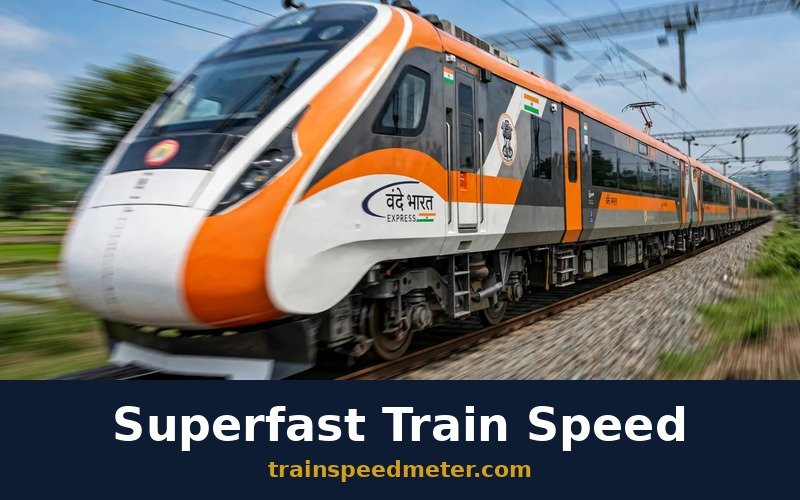
Superfast train speed in India is defined by an average, not a top speed. A broad-gauge passenger train that averages at least 55 km/h end to end earns the superfast tag. Most superfast express trains average 55–75 km/h, while Rajdhani and Shatabdi services average 80–90 km/h. Maximum permitted speed is usually 130 km/h, rising to 160 km/h on select sections. A live speed tracker shows what the train is really doing.
What “Superfast” Actually Means on Indian Railways
Most travellers assume “superfast” describes how fast the train can go. It describes how fast the train averages over the whole run, halts included.
Indian Railways fixed the rule in May 2007. A train qualifies if its average speed, in both up and down directions, is at least 55 km/h on broad gauge (or 45 km/h on metre gauge). That is roughly 34 mph. Wikipedia’s overview of express trains in India uses the same threshold. A Lok Sabha reply notes that end-to-end average speeds of superfast trains range from about 55 to 73 km/h.
Two points follow from this:
- A train can touch 130 km/h and still barely qualify if it crawls through congested sections.
- A train with a 110 km/h limit can qualify comfortably if it runs with few stops and few delays.
You can usually spot a superfast train by its number. Superfast services typically carry numbers starting with 12 or 22, such as 12418 or 22420. Ordinary express and mail trains sit in the 13, 14 and 15 series.
Superfast Express Average Speed: What to Expect
Average speed determines your travel time, so it matters more than top speed. Here is how it breaks down.
Typical superfast express: 55–65 km/h. This covers most overnight and long-distance trains on busy routes.
Premium superfast services: 80–90 km/h. A well-known benchmark list from IIT Delhi ranks the Mumbai Rajdhani first at about 86 km/h commercial speed, followed closely by the Sealdah Duronto and the Howrah Yuva Express at around 85 km/h. That list dates from 2015, so schedules have shifted since. The ranking still shows the pattern: non-stop or low-halt trains with priority paths win.
Vande Bharat on its best routes: 90+ km/h. The New Delhi–Varanasi service is listed at about 95 km/h average, and the Rani Kamalapati–Hazrat Nizamuddin service at about 92 km/h.
In practice, a 600 km journey at 55 km/h takes nearly 11 hours. At 75 km/h it takes 8 hours. Those three hours are the real gap between an ordinary superfast train and a premium one.
Superfast Train Maximum Speed in India
Maximum speed is a different number, and the two are often confused. It is also called maximum permissible speed (MPS). It is the highest speed a train may legally run on a given section, set by the track, signalling, coach design and locomotive.
Here is where the limits sit today:
- 110–130 km/h: most superfast and mail/express trains.
- 130 km/h: Rajdhani and Shatabdi services on most routes, and many Vande Bharat routes.
- 160 km/h: select corridors, notably the Tughlakabad–Agra section used by the Gatimaan Express and one Vande Bharat service. The Wikipedia article above describes this as the highest operational speed on Indian Railways.
- 180 km/h: the Vande Bharat design speed. It has been demonstrated in trials but is not used in regular service.
Track sections across the network are rated from 80 to 200 km/h, yet the highest commercial speed stays at 160 km/h. The reason is practical: sharing lines with slower freight and local trains, level crossings, curves and signalling spacing all hold trains back.
A parliamentary committee has also pointed out that the superfast benchmark of 55 km/h is low given what modern rolling stock can do. We come back to that below.
Superfast Train vs Express Train Speed
The gap between categories is smaller on paper than most people expect. This table puts the main differences side by side.
| Feature | Superfast train | Mail / Express train |
| Qualifying average speed | 55 km/h or more (broad gauge) | Below the superfast threshold |
| Typical train numbers | 12xxx, 22xxx | 13xxx, 14xxx, 15xxx |
| Typical average speed | 55–75 km/h | 40–55 km/h |
| Stops | Fewer, at major stations | More, including smaller stations |
| Surcharge | Yes, a flat superfast charge per class | No superfast charge |
| Track priority | Higher | Lower |
| Best for | Long-distance, time-sensitive trips | Reaching smaller towns, lower fares |
Superfast trains charge a flat supplement on top of the base fare. Railway fare tables have listed it at ₹75 for First AC, ₹45 for AC 2-tier, AC 3-tier and AC chair car, ₹30 for Sleeper and ₹15 for Second Sitting. Fares are revised from time to time, so check the booking page before you pay.
Superfast Train Stoppages and Speed
Stoppages matter more than top speed in deciding a train’s average. Every halt costs time twice: once for braking and standing, and again for getting back up to speed.
A practical way to see this is to compare a few trains from the same corridor:
- The Allahabad Duronto makes only a single technical halt on its Delhi run, which is why it sits among the fastest averages.
- The Maharashtra Sampark Kranti has only three halts on Delhi–Mumbai and is the fastest of its kind, yet it is held to a 110 km/h limit.
- A superfast train with 12 or 15 halts over the same distance can finish the trip an hour or two behind a similar service with six or seven.
Before you book, look at the number of halts and the gap between them. Long stretches between stops give a train room to hold its permitted speed.
How Fast Is Each Type of Superfast Train? A Quick Comparison
This table covers the main premium services under the superfast umbrella. Figures are maximum permitted speeds on the stated section and typical averages, so your actual run may differ.
| Train type | Maximum speed | Typical average speed | Notes |
| Vande Bharat Express | 130–160 km/h (design 180) | 83–95 km/h | Self-propelled; many routes capped at 130 km/h |
| Gatimaan Express | 160 km/h | ~91 km/h | Delhi–Agra stretch is the fastest in India |
| Shatabdi Express | 130–150 km/h | 75–85 km/h | Daytime, chair car |
| Rajdhani Express | 130–140 km/h | 80–86 km/h | Overnight, long distance |
| Duronto Express | 120–130 km/h | 80–85 km/h | Non-stop or near non-stop |
| Garib Rath | 130 km/h | 75–80 km/h | Budget air-conditioned travel |
| Standard superfast express | 110–130 km/h | 55–65 km/h | The most common type |
Want to see how these numbers hold up in real conditions? Our Shatabdi speed test, Gatimaan speed test and Vande Bharat speed test pages show what GPS readings look like on each.
Why Real Speed Falls Below the Permitted Maximum
This is the question the timetable never answers. If a train is allowed 130 km/h, why does it average 60?
Mixed traffic. Passenger, goods and suburban trains share the same tracks. A fast train stuck behind a slower one loses time it cannot recover.
Speed restrictions. Curves, bridges, level crossings, yards, junctions and ongoing maintenance work all force the train to slow.
Signalling and spacing. Safe following distances limit how many trains can run close together at speed.
Acceleration and braking. Locomotive-hauled trains need time to build speed again after each halt. Self-propelled trains like Vande Bharat do this faster, which is why they hold up well even on routes capped at 130 km/h.
Infrastructure and safety checks. Corridors cleared for higher speeds are still few. An RTI reply reported that Vande Bharat trains on one route averaged about 83 km/h against a permissible 130 km/h.
A recent parliamentary review adds an official angle. The Public Accounts Committee’s report, Punctuality and Travel Time in Train Operations in Indian Railways, was tabled in Lok Sabha on 4 February 2026. It noted that out of 478 superfast trains, 123 have a scheduled speed below 55 km/h. It also called the 55 km/h benchmark conservative and recommended a review towards global standards of roughly 100 km/h. Business Standard’s coverage summarises the findings. The same report flagged a fall in punctuality from 90 per cent in 2021–22 to 73.62 per cent in 2023–24.
For a passenger, the takeaway is simple: the superfast label guarantees a surcharge, not a particular speed.
Superfast Train Live Speed Tracker: How to Check Real Speed
A timetable tells you what is planned. A live tracker tells you what is happening. There are two ways to see it.
Method 1: GPS speedometer on your phone
This is the most direct way to read the speed of the train you are actually on.
- Turn on location services and set it to high accuracy.
- Open a GPS speedometer app that displays speed in km/h.
- Sit near a window. Signal is stronger there, and metal coach bodies block GPS indoors.
- Wait for a steady fix before you trust the reading. It can lag for the first minute.
- Compare readings at different points along the route: after departure, on open track, near stations, and on curves.
GPS speed is calculated from position change, so brief dips in the reading are normal. Look at the trend over a few minutes rather than a single number. You can see an example of this approach on Train Speed Meter.
Method 2: Running status updates
Running status shows where the train is, how late it is, and what its expected arrival is. It does not show instantaneous speed. It does help you work out whether the train is making up time. A train that is 40 minutes late and gains 10 minutes between two stations is clearly running well above its scheduled pace.
For the best picture, combine the two: use running status for position and delay, and GPS for the actual speed on the stretch you care about.
Superfast Train Running Status and What It Tells You About Speed
Running status becomes useful once you know how to read it.
- Late departure, on-time arrival. The train is recovering time, so it is running at or near its permitted speed.
- Steady delay that does not change. The train is running to schedule but started late.
- Delay that grows between stations. Something is slowing it, such as congestion, a restriction, or waiting for a clear signal.
If you have a connection to make, this reading is more reliable than the printed arrival time.
Pro Tips for Choosing a Fast Train
- Compare average speed, not the label. Divide the distance by the scheduled journey time. This takes ten seconds and tells you more than the train’s name.
- Count the halts. Fewer stops usually mean a faster trip.
- Check the corridor. Delhi–Agra, Delhi–Kanpur and Delhi–Mumbai have the strongest premium paths.
- Prefer self-propelled sets like Vande Bharat on routes where they run, since they accelerate faster.
- Read the surcharge as a cost, not a speed promise. Verify it against the schedule before you pay.
- Travel by day on short routes. Daytime Shatabdi and Vande Bharat services often beat overnight ones on door-to-door time.
Who Benefits From Knowing Superfast Train Speeds
Business and time-bound travellers need predictable arrival times and should pick trains by scheduled average speed and past punctuality.
Students and families can use the speed gap to choose between a cheaper slower train and a pricier fast one on journeys under about 600 km.
Railfans and hobbyists use GPS readings to compare real running speed against the permitted maximum.
Travel bloggers and researchers can use the average-versus-maximum split to explain why official numbers and real experience differ.
Common Mistakes People Make
- Treating maximum permissible speed as the speed you will actually travel at.
- Assuming every superfast train is a premium train. Many are ordinary express services with a surcharge.
- Trusting the first GPS reading after boarding, before the signal settles.
- Ignoring the number of halts when comparing two trains on the same route.
- Reading old speed rankings as current. Schedules and corridor limits change year to year.
FAQs
What is the average speed of a superfast train in India?
Most superfast trains average between 55 and 65 km/h end to end, and the official minimum is 55 km/h on broad gauge. Premium services such as Rajdhani, Shatabdi and Vande Bharat average 80–95 km/h on their best routes, because they make fewer stops and get track priority.
What is the maximum speed of a superfast train in India?
Most superfast trains are permitted up to 110–130 km/h. Select corridors, such as Tughlakabad–Agra, allow 160 km/h for the Gatimaan Express and one Vande Bharat service. The Vande Bharat design speed is 180 km/h, but commercial running stays below that.
How is a superfast train different from an express train?
A superfast train must average at least 55 km/h and charges a flat superfast supplement. An ordinary express or mail train averages less, stops more often, and does not carry the surcharge. Superfast trains usually have numbers starting with 12 or 22.
Is a Vande Bharat faster than a regular superfast train?
Usually yes. Vande Bharat sets an average of around 83–95 km/h on many routes, compared with 55–65 km/h for a standard superfast express. It accelerates faster and has a higher design speed, though many routes still cap it at 130 km/h.
Can I track the speed of a superfast train live?
Yes. A GPS speedometer on your phone shows the speed of the train you are on in km/h. Running status apps show position and delay but not instant speed. Using both gives the clearest picture of how your train is performing.