
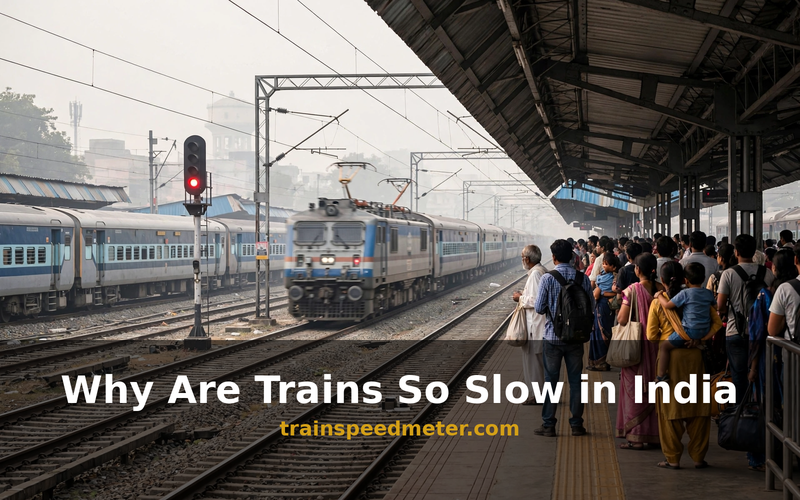
Trains are so slow in India mainly because of congestion, not weak engines. Mixed passenger and freight traffic shares the same tracks, many busy routes run beyond capacity, and permanent speed restrictions, signal failures and maintenance blocks keep average speeds low. Most Mail and Express trains average about 50 to 55 km/h, even though many are designed to run at 110 to 130 km/h. That gap is why Indian trains are so often late.
Ask a regular passenger why Indian trains feel slow and you will usually hear “because the tracks are old.” That is part of the answer, but it misses the bigger point.
The question is not how fast a train can go. It is how fast it can go on average, with every halt, crossing, signal stop and restriction included. A Rajdhani may be cleared to 130 km/h on a good stretch. Over a full journey, the number that matters is the average, and that is where Indian Railways loses most of its time.
India is a tough case for any railway. In 2023-24, Indian Railways carried around 6.9 billion passenger journeys across a network of roughly 69,000 route kilometres, which is about 19 million people a day. Few railways in the world move this many people on so little track.
What the Numbers Say About Train Speed in India
Speed on paper and speed in practice are very different things.
| Train category | Typical maximum speed | Typical average speed |
| Gatimaan Express | 160 km/h (short stretch) | About 80–95 km/h |
| Vande Bharat Express | 130 km/h in service (160 km/h design) | About 75–95 km/h on many routes |
| Rajdhani / Shatabdi | 130 km/h | About 70–85 km/h |
| Superfast Mail/Express | 110 km/h | About 55–65 km/h |
| Ordinary Mail/Express | 100–110 km/h | About 45–55 km/h |
| Passenger / local trains | 75–100 km/h | About 30–40 km/h |
| Freight trains | 75–100 km/h | About 25 km/h |
Averages vary by route and season, so treat these as ballpark figures rather than exact numbers.
Railway ministry figures reported in Parliament put the average speed of Mail and Express trains at 50.3 km/h in 2017 and only 51.1 km/h in 2023. That is a rise of less than one km/h in six years. If you want to see how fast a specific service really moves, you can run a live speed test on your own train and compare it against the timetable.
Why Are Trains So Slow in India? The Main Causes
1. The tracks are overcrowded
Congestion is the single biggest reason. Under the National Rail Plan, more than 80% of India’s busiest corridors, the High-Density Network linking major cities, run above their rated capacity. At least 22% run above 150% utilisation.
Line capacity here means the number of trains a section can handle in 24 hours. When a corridor is pushed past 100%, there is no slack. One late train delays the one behind it, which delays the next, and so on down the line.
The imbalance is stark. About 45% of the network sits below 70% utilisation, while roughly 1% of it carries more than 150%. The pressure is concentrated on the trunk routes that connect Delhi, Mumbai, Kolkata and Chennai. Those are the routes most people travel.
2. Fast, slow and freight trains share the same lines
Indian Railways is a mixed-traffic network. A Rajdhani, a local passenger service and a loaded coal train may all use the same pair of tracks. Their speeds differ enormously, so the faster trains keep catching the slower ones, and one of them has to give way.
This is why you sometimes sit at an “outer” signal just outside a big station. The platform is occupied and the line ahead is full, so you wait.
3. Priority trains push other trains aside
Premium trains such as Rajdhani, Shatabdi and Vande Bharat get right of way. Superfast and ordinary Express trains are held in loop lines so the priority train can pass. A two-minute halt becomes fifteen. Over a journey of 1,500 km, several such waits can add hours.
4. Single-line sections and loop lines
Many routes are still single track or recently doubled. On a single line, two trains travelling in opposite directions must cross at a station, so one stops and waits. Doubling projects are under way. The parliamentary standing committee on railways noted in August 2025 that fund use on doubling had not kept pace with physical progress.
5. Permanent and temporary speed restrictions
Tracks are rated for a safe speed. Where track condition, curves, old bridges, ghat sections or level crossings demand it, a Permanent Speed Restriction (PSR) is imposed. A CAG audit found the Western Railway zone had 685 such restrictions, against 56 on Southern Railway.
Then come Temporary Speed Restrictions (TSRs). These are set after track repairs, bridge work or a defect, and they can stay for weeks. A train may be capable of 130 km/h but crawl at 20 or 30 km/h over a restricted stretch.
6. Maintenance has no breathing room
You cannot repair a track that is occupied every few minutes. Because the busiest lines are always full, there is little time for engineering blocks and inspections. Skipped or delayed maintenance then produces more defects and more restrictions.
Audit findings reinforce the point. A CAG report on derailments found more than half of the track-recording car inspections were missed in 2017-2021. Another CAG audit reported locomotive failures rising 400% over four years to 24,147 in 2018, and overhead equipment failures climbing about sevenfold to 2,759. Asset failures accounted for an average of 22.2% of punctuality loss in 2018.
7. Signal failures and equipment breakdowns
Signalling is the nervous system of a railway. When a signal fails, trains drop to a cautious speed or stop altogether. In September 2025 the Ministry of Railways itself warned that repeated signal failures posed a serious threat to safety and reliability.
Diesel locomotive failures also hurt. Since April 2023, they have caused more than 4,400 punctuality-loss cases, which works out to about five a day. When a diesel engine dies mid-section, the train waits for a relief engine, and everything behind it waits too.
8. Station and platform shortages
Long 24-coach trains need long platforms. Where platforms are short, stabling and pit lines are scarce, or station decongestion work is unfinished, trains queue outside the station. CAG audits of station redevelopment have pointed to exactly these gaps.
9. Weather, animals, people and level crossings
Dense winter fog across the north Indian plains forces loco pilots to slow down and keeps signals hard to see. Cattle on tracks, trespassers, chain pulling and law-and-order incidents add unplanned stops. Unmanned level crossings on broad gauge have been eliminated, but unauthorised crossings and unfenced tracks near towns still force slow running.
10. Timetables that are built around congestion
Here is something competitors rarely explain. In many countries, a timetable is built from the line’s speed capability and then traffic is fitted around it. In India, the schedule is often shaped by how many trains the line can absorb. Padding, called slack or cushion time, is added so a train can lose time and still arrive “on time.”
So the scheduled run is already slower than the track allows. A train can be 20 minutes late against a timetable that was generous to begin with.
Why Are Indian Trains Always Late? Measuring Punctuality
A train counts as on time in India if it arrives within 15 minutes of schedule. By comparison, Germany uses 5 minutes and Britain uses 10. Even with that lenient yardstick, the punctuality index fell from 94.17 in 2020 to 73.62 in 2023, according to figures reported by IndiaSpend.
In 2017-18, Mail and Express punctuality was about 71%, down from about 77% the year before. Railway officials often point to higher figures for specific divisions, so the headline number depends on what is being counted. For you as a passenger, the experience is simple: long journeys on busy corridors are the most likely to run late.
Why Raising Top Speed Isn’t the Fix
Many people assume faster engines will solve everything. They will not. India already has about 80,000 km of track rated for 110 km/h or more and 23,000 km rated for 130 km/h, according to figures reported as of April 2025.
Former IIM Bangalore director G. Raghuram has argued that raising average speed matters more than raising maximum speed. His levers are fewer halts, station layouts that allow main-line overtakes, grade separation at major junctions and removal of unnecessary restrictions.
You can see the logic at big terminals. On the approach to a busy city station, the last 30 km can take up to two hours because the line is jammed with trains waiting for platforms.
Mission Raftaar: What It Promised and What Happened
Launched in 2017, Mission Raftaar aimed to double freight speed from 25 to 50 km/h and lift Mail and Express speeds from 50 to 75 km/h by 2022. Passenger averages crept up by about one km/h, and freight improved by only a fraction. The CAG singled out permanent speed restrictions as a major obstacle.
That does not mean no progress was made. The government says about 31,000 km of new track has been laid and 45,000 km renewed since 2014. Broad gauge electrification reached 99.1% by October 2025. Electric traction accelerates faster and is more reliable, and it removes the diesel-failure problem on electrified routes.
Is India Slow Compared to Other Countries?
| Factor | India | Japan | China |
| Typical conventional passenger average | 50–70 km/h | 80–120 km/h | 80–120 km/h |
| High-speed rail | Under construction (Mumbai–Ahmedabad) | Shinkansen since 1964 | Over 40,000 km network |
| Traffic model | Mixed passenger and freight | Largely separated passenger lines | Separate high-speed network |
| On-time standard | 15 minutes | Under 1 minute (commonly cited) | Varies by service |
| Passenger load | Extremely high | Very high in cities | Very high |
India is not the slowest railway in the world, but its conventional network is slow for a system of this importance. The comparison with Japan is also unfair in some ways. Japan’s high-speed lines are separate, grade-separated and fenced. India runs a 19-million-passenger-a-day network largely on shared, legacy tracks.
Which Are the Slowest Trains in India?
Slowness is not only a congestion issue. The Nilgiri Mountain Railway in Tamil Nadu, a rack-and-pinion line between Mettupalayam and Ooty, averages around 10 km/h. It is slow by design, because it climbs steep hills. Many ordinary passenger trains and mountain heritage lines run slowly for similar terrain reasons.
For plain-land Mail and Express trains, though, slowness comes from the causes above: stops, waits and restrictions, not terrain.
How to Improve Train Speed in India
The fixes are well known. The difficulty is money, land and time.
- Dedicated Freight Corridors. Moving freight to its own lines frees up passenger capacity on the old routes. The Dedicated Freight Corridors are the biggest single step, though their full benefit depends on how much freight actually shifts across.
- Third and fourth lines on trunk routes. Adding tracks on the most congested sections increases capacity directly.
- Automatic signalling and Kavach. Automatic block signalling allows trains to run closer together safely, and Kavach, the indigenous train-protection system, supports higher speeds with more safety.
- Removing speed restrictions. Track renewal, stronger sleepers and bridge upgrades reduce the need for PSRs.
- Grade separation and fencing. Eliminating level crossings and fencing the track allows sustained running at 130 km/h and above.
- Faster rolling stock. Distributed-power trainsets such as Vande Bharat accelerate quickly and keep moving even if one unit fails.
- Smarter timetabling. Reducing unnecessary halts and building schedules around real capacity would cut waiting time.
- Better maintenance planning. Planned, longer maintenance windows lower breakdowns and reduce emergency restrictions.
For longer-term context, the National Rail Plan 2030 sets out freight speed targets, capacity expansion and a push toward high-speed rail.
Vande Bharat, Gatimaan and Shatabdi: Are Premium Trains Really Fast?
Premium trains are faster, but not as fast as their labels suggest. The Gatimaan Express touches 160 km/h on a short stretch, and Vande Bharat trainsets are designed for 160 km/h. In day-to-day service, most run at up to 130 km/h and are limited by the same tracks as everything else.
You can compare real performance for yourself through the Gatimaan speed test, the Shatabdi speed test and the Vande Bharat speed test. The gap between the number printed on the timetable and the speed on your screen is often the most telling part.
Pro Tips for Travellers on Slow Routes
- Check punctuality before booking. Corridors out of Delhi, Mumbai and the Gangetic plains are the most delay-prone in winter.
- Avoid tight connections. Leave at least 3 to 4 hours between a long-distance arrival and any onward travel.
- Prefer premium trains for deadlines. Rajdhani, Shatabdi and Vande Bharat receive priority and generally hold time better.
- Travel outside peak fog months (December to January) on northern routes where you can.
- Use a speed tracker. A GPS-based speed meter shows whether a delay is from slow running or from long halts, which tells you whether the time will be recovered.
Who Needs to Know This? Use Cases by Reader
- Daily commuters can judge which services hold time and which don’t.
- Students and exam travellers can plan buffers around known delay corridors.
- Railfans can compare scheduled and actual speeds and see how restrictions affect each section.
- Researchers and journalists can use official figures such as CAG audits and the National Rail Plan as source material.
- Freight and logistics planners need to understand that freight averages of about 25 km/h shape delivery times.
So, Why Are Trains So Slow in India?
The short answer to why trains are so slow in India: too much traffic on too little track, with restrictions, breakdowns and shared lines turning fast trains into slow ones. Modernisation is real, with near-complete electrification, new tracks and Kavach. The benefit will show up in average speeds only when capacity grows and freight moves off the passenger lines. Until then, the difference between a train’s top speed and its journey average will remain the number that matters most.
FAQs
Why are trains so slow in India compared to Japan or China?
India runs fast and slow passenger trains and heavy freight on the same shared tracks, while Japan and China built separate high-speed lines. Add legacy infrastructure, speed restrictions and very high passenger loads, and the average speed of trains in India stays far below those countries.
What is the average speed of trains in India?
Mail and Express trains average roughly 50 to 55 km/h, superfast services run around 55 to 65 km/h, and premium trains such as Rajdhani and Shatabdi manage 70 to 85 km/h. Passenger trains are slower, at about 30 to 40 km/h, and freight trains average around 25 km/h.
Why are Indian trains always late?
Mostly because of congestion and cascading delays. When a corridor is over capacity, a single late train holds up many others. Signal failures, engineering work, priority given to premium trains, fog and unplanned stops add to it. A train is counted on time if it arrives within 15 minutes.
Why do Indian trains stop at outer signals?
The platform or line ahead is occupied, so the train must wait until it clears. At busy junctions, several trains converge at once. Faster, higher-priority trains may also be allowed through first, leaving the lower-priority train waiting outside the station.
Which is the fastest train in India?
The Gatimaan Express reaches 160 km/h on a short section, and Vande Bharat trainsets are designed for 160 km/h. In regular service, most premium trains run at up to 130 km/h, so their real-world speed depends on the corridor.