
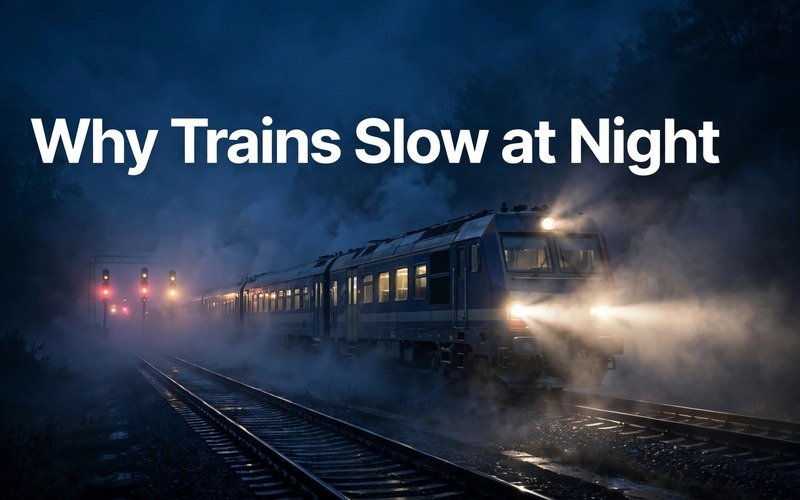
Why trains slow at night usually comes down to four things: fog and poor visibility, temporary speed restrictions where track work is happening, signals that hold a train behind slower traffic, and timetables that deliberately build in slack. Posted speed limits don’t change after dark. Why do trains run slower at night in some cases and faster in others? Because the cause is rarely the clock. It is the section of track, the weather, and what is running ahead of you.
Do Trains Actually Slow Down at Night?
Not as a rule. Many passengers insist their train crawls after sunset. Others swear it flies. Both are right, depending on the route.
The line speed limit for a stretch of track is the same at 2 p.m. and 2 a.m. What changes is everything around that limit. During the day, a busy corridor carries local services, expresses and freight, all fighting for the same paths. At night, many of those disappear. A train can run closer to its permitted speed for longer.
But “closer to the limit” isn’t the same as “at the limit.” Night adds its own problems: reduced visibility, engineering work, and timetables written for comfort rather than speed. So the honest answer to “are night train speed slower than day train speed” is that some are, some aren’t, and it depends on the type of train and the stretch it runs on.
Reduced Visibility Train Driving at Night
Darkness itself doesn’t force a train to slow. Modern colour-light signals are in fact easier to spot at night, because the lamps stand out against a dark background. In strong sun, a signal lens can wash out, which is why daytime glare causes its own cautious driving.
The real visibility problem is fog and mist, and in northern India, winter fog is the best-known example. When a driver can’t see a signal from a safe braking distance, the safe choice is to reduce speed. Indian Railways uses GPS-based fog safety devices that call out upcoming signals inside the cab, which helps, but fog operating rules still hold speeds well below normal in the worst conditions. In practice, a train that crawls through a foggy stretch at 3 a.m. is following a rule written after hard lessons.
Visibility also affects what a driver can see beside the track. Animals, trespassers and objects on the line are harder to spot after dark, so drivers are more careful approaching unprotected crossings, sharp bends and vulnerable bridges.
Railway Track Maintenance at Night
This is the cause people miss most often, and it’s where the common claim “no maintenance happens at night” falls apart.
Railways schedule a lot of engineering work overnight on purpose. Track patrols, ultrasonic rail testing, signal repair, sleeper replacement and overhead wire work all need access to the line. Doing it when fewer trains are running reduces disruption for the largest number of passengers. So night is often when the work gets done.
That work shows up for passengers in two ways:
Blocks: a section is closed entirely for a set period, and trains are rerouted or held until it reopens.
Temporary speed restrictions: after work, or where a fault has been found, trains must pass a section at a reduced speed until the track settles or the repair is finished.
Rail engineers know this well. Freshly tamped or relaid track doesn’t hold its alignment immediately, so it’s safer to run slowly across it for a while. Drivers receive these restrictions in writing before the journey and see them marked trackside. A single temporary restriction of 20 km/h across a short stretch can cost a train several minutes once you add braking and re-acceleration.
In the UK, engineers have long noted that line speeds don’t change at night, but sections of track are more likely to be out of use, which forces diversions and slower paths.
Night Train Speed Restrictions: What the Rules Look Like
A train’s speed at any moment is the lowest of several limits:
The permanent line speed, set by the condition and design of the track
The train’s own limit, based on its design and brakes
Temporary restrictions for work, track defects or weather
The signal aspect in front of the driver
Night mostly affects numbers 3 and 4. A signal showing a restrictive aspect (a yellow or a double yellow in many systems) tells the driver to be ready to stop at the next one. If the train ahead has been delayed, every train behind it picks up those cautionary signals. That’s why you can be moving smoothly one minute and creeping the next with no obvious reason outside the window.
For readers curious about the system behind this, the basics of railway signalling explain how block sections keep trains a safe distance apart. Spacing between trains is the single biggest reason one late train can slow everyone behind it.
Freight Trains vs Passenger Trains at Night
Freight and passenger trains share a huge portion of the network, and their needs clash. Freight trains are long, heavy and slow to accelerate. Many are limited to around 80–100 km/h, well below express passenger limits. During the day, passenger services get priority, so freight waits in loops and sidings.
At night, that flips in practice. Passenger services thin out, and freight gets more room to run. The result for an overnight passenger train is that you may end up behind a slow-moving goods train on a line with few places to overtake. On single-track routes, you may also be held at a station until an oncoming train clears.
Freight movement is why some railway staff describe night running as “freight time.” If you’re in a passenger coach and notice repeated stops at small stations at 1 a.m., a crossing with a goods train is a very common explanation.
Why Sleeper Trains Are Slower on Purpose
This is the part many competitors skip. Overnight sleeper services are frequently timed slow by design.
Think about it from the operator’s view. A sleeper that could reach its destination at 3:30 a.m. would wake passengers at an unreasonable hour, block a platform and force a long wait for station services to open. So the timetable stretches the journey, and drivers are expected to keep to it rather than run flat out.
Railway staff on the European and British sleeper routes have described the same logic: the slow timing is deliberate, it keeps the ride quieter and more comfortable, and it leaves a cushion for the diversions that engineering work often forces overnight. In practice, a sleeper that’s running on time may be held back to avoid arriving early. If it’s running late, the driver can use the spare capacity to recover.
Slack Time: Why Trains Seem to Crawl Mid-Journey
Timetable planners add small buffers called slack, or recovery time, between stations. A segment that could be covered in 40 minutes might be scheduled for 55. The extra time absorbs minor delays so one hold-up doesn’t ruin the whole journey.
If your train is on time, you’ll feel the slack as slow running or an unexplained wait. If it’s late, the driver uses that same buffer to catch up, and it feels like the train suddenly speeds up. This is probably the biggest reason people say “trains make up time at night.” The timetable has room in it, and there’s less traffic competing for the line.
You’ll often see the pattern near the end of a route: average speeds drop sharply in the last stretch before a terminal, because the planners know the train must not arrive ahead of its platform slot.
Rail Temperature, Cold Nights and Track Behaviour
Temperature matters to steel rails more than most people expect. Modern continuous welded rail has no gaps to absorb expansion, so it’s laid under tension and set to a neutral temperature. On very hot afternoons, rails can build up compressive force and risk buckling, which is why railways impose heat-related speed restrictions on vulnerable stretches.
At night, the opposite happens. Rails cool and contract, which lowers buckling risk but increases tension. Extreme cold can raise the chance of rail breaks, especially at weld points, so some railways reduce speeds or increase inspections in severe winter. So cooler nights can help in summer and hurt in a cold snap.
A common claim is that engines run better because it’s cooler at night. That’s a minor factor at best for modern locomotives. Track condition and signals matter far more.
Day vs Night: Side-by-Side Comparison
| Factor | Daytime | Night |
| Line speed limit | Same | Same |
| Passenger traffic | Heavy | Lighter |
| Freight traffic | Held for passenger priority | More movement, can block overtaking |
| Engineering work | Limited by traffic | More frequent, blocks and restrictions |
| Visibility | Glare can hide signals | Lamps stand out; fog is the main risk |
| Signal delays | Frequent in dense areas | Fewer, but a late train causes a chain effect |
| Timetable design | Built for speed and frequency | Sleepers timed slow for comfort |
| Perceived speed | Landmarks show true pace | Darkness removes reference points |
Train Delays at Night: Causes Passengers Overlook
Beyond the big reasons, a few smaller ones add up:
Level crossings and trespass risk. Drivers slow where crossings are unmanned or where people regularly walk the line.
Crew change and loco swaps. Overnight halts at junctions can take longer than daytime ones because there’s less staff on duty.
Waiting for a path. A train that left late may have lost its slot and now waits for a gap between others.
Station dwell. Night services often make longer stops at interchange stations to connect with feeder services.
Fog and weather cascades. Early-morning fog in winter delays the first trains, and those delays ripple back across the network.
Why Night Trains Feel Faster (or Slower) Than They Are
Human perception is a poor speedometer. In daylight, you judge speed from poles, trees and buildings flashing past. At night, those reference points vanish, and a steady 80 km/h can feel either like a rush or a crawl, depending on lighting, noise and how tired you are. Coach vibrations and the rhythm of rail joints also feel more pronounced in a dark compartment.
This is exactly why measuring beats guessing. A GPS-based tool shows your real speed regardless of what your senses say. On trainspeedmeter.com, you can check live speed on your own journey and compare it with recorded runs such as the Shatabdi speed test, the Vande Bharat speed test or the Gatimaan speed test. Fast premium services like these tend to hold their top speeds in clear sections and drop sharply only for restrictions, stations and curves, which makes slowdowns easy to spot on the graph.
How to Check Whether Your Train Is Really Running Slow
If you want an answer instead of an impression, follow these steps:
Open a GPS speed meter on your phone before departure and let it lock a signal.
Note the time and speed at a few fixed points, such as before and after a station.
Compare against the route’s usual running speed. Express trains on cleared main lines often run well above regional averages.
Look for dips. A short sharp drop usually means a restriction, curve or signal. A long, low plateau suggests slack time or traffic ahead.
Check the official source. Real-time running status and notices are published through Indian Railways, and other national operators publish equivalent disruption notices.
Pro tip: sit by a window with a view of the signals when you can. If the aspect in front changes from green to yellow just before you slow, you’ve found your answer.
Who Benefits From Understanding This
Regular commuters can plan around the busiest engineering periods and stop blaming the driver for slowdowns that are procedural.
Overnight travellers can choose between a fast night express and a slower sleeper depending on whether they want an early arrival or a full night’s rest.
Railfans and content creators get cleaner speed data from clear, signal-free stretches than from mixed-traffic corridors.
Business travellers who need a predictable arrival are better off on services with a good punctuality record than on the one with the fastest scheduled time.
Pros and Limits of Night Rail Travel
Night travel has real upsides. It saves a hotel night, avoids road congestion, and often gives a smoother run on lightly loaded lines. The downsides are just as real: engineering blocks, fog exposure in winter, and timetables that prioritise comfort over speed. No single rule applies across countries, operators or seasons, and anyone who says trains are always faster or slower at night is generalising.
What to Remember About Why Trains Slow at Night
Why trains slow at night isn’t a mystery once you separate the myths from the mechanics. The speed limit stays the same. What changes is visibility, track access, freight movement and how the timetable is written. Fog and temporary restrictions cause genuine slowdowns. Slack time and sleeper pathing cause deliberate ones. And darkness distorts how fast any of it feels. The next time your overnight train eases down to a crawl, look at the signal ahead, think about what’s on the line in front of you, and check your speed meter. The answer is almost always out there in the dark.
Frequently Asked Questions
Why do trains slow down at night?
Mostly because of fog, temporary speed restrictions from track work, restrictive signals caused by traffic ahead, and slack built into the timetable. The speed limit itself doesn’t drop after dark. If your train slows, it’s reacting to conditions on that stretch, not to the time of day.
Are night trains slower than day trains?
It depends on the type. Sleeper services are often timed slowly on purpose, so they don’t arrive at unsociable hours. Express trains on quiet lines can actually run closer to their top speed overnight. Compare the same train’s day and night pace before concluding anything.
Do trains run faster at night in India?
Often they appear to, because passenger traffic thins out and signals clear sooner. Late trains also use timetable slack to recover time. But engineering work and winter fog can offset this. The speed limit is identical, so the difference comes from fewer interruptions, not a higher limit.
Does fog make trains slow down?
Yes. When a driver can’t see signals from a safe braking distance, speed must come down. In northern India, fog rules can hold trains well below normal speed in dense conditions. GPS-based fog devices help by announcing signals inside the cab, but they don’t remove the need for caution.
Is track maintenance done at night?
Frequently, yes. Railways schedule inspections, repairs and signal work overnight because fewer trains are running. That can mean blocked sections, diversions and temporary speed restrictions afterwards. Not every night has work, but it’s one of the most common reasons for unexpected slow running after dark.