
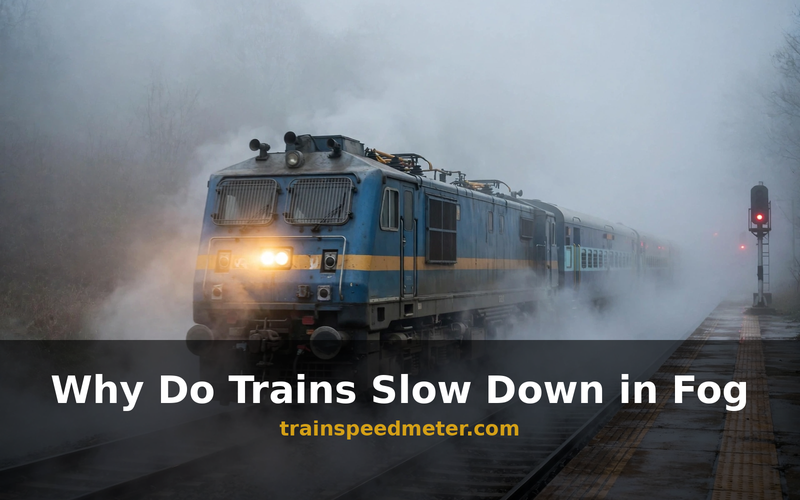
Trains slow down in fog because drivers can’t spot signals, level crossings, or obstacles early enough to stop. A heavy train can need a kilometre or more to brake, yet dense fog can drop visibility below 100 metres. To stay safe, railways impose fog speed restrictions and space trains further apart. That is why fog delays spread across an entire network, not just a single line.
The Real Reason: Stopping Distance vs. Sight Distance
A car driver who sees a hazard can brake and stop within a few dozen metres. A train cannot. Steel wheels on steel rails have very little grip, and a loaded passenger train weighs hundreds of tonnes. A train doing 110 to 130 km/h typically needs somewhere around a kilometre, sometimes more, to come to a full stop.
That one number explains almost everything about fog. Railway signalling is designed around a simple promise: the driver sees a signal, reads it, and has enough room to react. In clear weather a driver can spot a colour-light signal from well over a kilometre away. In dense fog that drops to a few hundred metres, then to 100 metres or less.
When sight distance becomes shorter than stopping distance, the only safe option is to reduce speed until the two match again. Everything else, from the rulebooks to the delays you see on the display board, flows from that gap.
How Fog Actually Forms (and Why North India Gets the Worst of It)
Most of the fog that disrupts rail travel is radiation fog. On a clear, calm winter night the ground loses heat quickly, the air close to the surface cools, and moisture condenses into tiny droplets that hang just above the ground. According to the overview of fog on Wikipedia, visibility below 1 km is what defines fog, and dense fog can bring it down to a few tens of metres.
The Indo-Gangetic plain, covering Punjab, Haryana, Delhi, Uttar Pradesh and Bihar, is almost perfect for this. The land is flat, winter nights are cold and still, and nearby rivers supply moisture. Add pollution from cities and crop-burning season, and fog turns into smog that is thicker and slower to lift even after sunrise.
This is also why fog affects one of the busiest rail corridors in the country. Our own readers on the Delhi–Kanpur–Prayagraj stretch will tell you the same: a one-hour fog patch at 5 a.m. can ruin the timetable until the evening.
What Happens in the Driver’s Cab
Seeing signals is the hardest part
On most of the network, the driver has no electronic copy of the signal in the cab. They have to see the signal with their own eyes. If a signal shows red, they must stop short of it. If it shows double yellow or single yellow, they must slow down and prepare to stop. A signal that can’t be seen can’t be obeyed, so drivers treat fog like a red light until proven otherwise.
The reading of the rulebook
Railways handle this through low visibility train driving rules, which cap speeds when fog is declared. Many railway staff describe it simply: in fog, trains run by caution rather than by the timetable. Commonly cited limits are around 60 km/h in declared fog, and far lower, even walking pace, when the driver can’t see the next signal at all. The exact numbers vary by zone, train type and whether the train carries a fog device.
How fog is officially declared
Stations don’t guess. A visibility test object, a marker placed at a fixed distance from the station master’s office (roughly 180 to 350 metres depending on the signalling type), is used as a yardstick. If the station master can’t see it, fog is declared and the cautionary rules apply. At night the object is lit.
The Safety Systems Railways Use in Fog
Fog signals on railways: fogmen and detonators
The oldest method is still in use. Railway staff called fogmen stand near signals in fog and place small explosive devices called detonators on the rail. When a wheel runs over one, it makes a sharp bang that warns the driver they are approaching a signal, even if they can’t see it. Many drivers will tell you that the bang is oddly reassuring in a white-out.
This system is slow and labour-intensive, which is why it is increasingly backed up by electronics.
Fog Safety Devices (FSD)
An FSD is a GPS-based handheld device given to drivers on fog-affected routes. It stores the locations of signals, level crossings and warning boards and gives audio and visual alerts as the train approaches them. Because it works on position, not eyesight, it helps the driver know a signal is coming even when it can’t be seen. The Ministry of Railways has described these devices in its official briefings on fog preparedness, and reports from early 2026 mention roughly 26,000 units provisioned for the winter season, most of them for Northern Railway.
An FSD helps, but it does not remove the speed restriction entirely. It is an alert, not an automatic brake.
Kavach: the long-term fix
Kavach is India’s own automatic train protection system. It uses trackside radio and RFID tags so that signal information appears inside the cab and the train can brake itself if the driver doesn’t respond. Kavach is being commissioned in phases, with newer versions rolled out on high-density corridors such as parts of Delhi–Mumbai and Delhi–Howrah. Once a line and train both have it, a driver no longer depends only on spotting a signal in the mist.
It is worth being honest about the limits. Kavach protects against signal-related mistakes, but it doesn’t clear cattle or people from the track. Fencing and the removal of level crossings matter just as much.
Other Reasons Fog Slows Trains Down
Signals get most of the attention, but they are only part of the picture.
- Level crossings: Vehicles and pedestrians are invisible until the last moment.
- Animals and trespassers: Cattle on the track are a real risk on rural routes.
- Track workers and patrolmen: Gangs working on the line can’t see a train coming either.
- Station approach: Drivers must see platform markers and points (switches) to enter the right line.
- Wet rails: Moisture can reduce wheel grip and slightly lengthen braking.
Why One Slow Train Delays Hundreds
This is the part most passengers miss. Fog doesn’t just slow your train; it slows the whole line.
Think of a double-track main line carrying a train every five minutes. Once every driver cuts speed to 60 km/h or lower, each train takes longer to clear every section. Signals can only clear for the next train when the previous one has left the section, so the gap between trains stretches. Many railways also deliberately reduce how many trains can be between two stations in fog.
The delay then cascades:
- A late train blocks the section for longer.
- Following trains wait outside stations for a clear signal.
- Crossing and overtaking plans fall apart.
- Crew duty hours run out and relief crews arrive late.
- Rakes arrive late for their next trip, so the delay carries into the next day.
That is why a Rajdhani can arrive 10 hours late while the weather at your destination is perfectly clear. Our readers testing speeds with the Train speed test during fog season often notice the same thing: the average speed is low for hours, and the train rarely recovers.
Speed in Fog vs. Speed in Clear Weather
| Condition | Typical visibility | Usual driving approach | Effect on schedule |
| Clear weather | 1 km or more | Full permitted speed | On time |
| Light mist | 500 m–1 km | Slightly reduced speed | Minor delays |
| Moderate fog | 200–500 m | Cautionary speed, around 60 km/h | Noticeable delays |
| Dense fog | 50–200 m | Further reduced speed, fog device and detonators | Hours of delay |
| Very dense fog | Under 50 m | Crawling speed, stop-and-go at signals | Severe delays, possible cancellations |
These bands are indicative. Actual limits depend on the zone’s rulebook and the equipment on the train.
How Rail Compares With Road and Air in Fog
| Factor | Train | Car | Aircraft |
| Stopping distance | Very long (1 km+) | Short | Not applicable once airborne |
| Depends on eyesight | Largely yes | Yes | Much less (instrument landing) |
| Can swerve around hazards | No | Yes | No |
| Shared with public/animals | Yes, at crossings | Yes | No |
| Fix available | Kavach, fencing | Fog lights | CAT III landing systems |
Aircraft can land in dense fog at properly equipped airports because they rely on instruments, not eyesight. A train still shares its corridor with the outside world, which is why technology alone can’t fully solve the problem without fencing and crossing removal.
What Premium and Fast Trains Experience
Fast trains feel fog most, because they have the most to lose. A train that normally cruises at 130 to 160 km/h can be forced down to a fraction of that. Our speed tests on the Shatabdi, Vande Bharat and Gatimaan corridors consistently show the same pattern. Top speed barely matters in fog; what matters is how long the train spends under the restriction.
Practical Tips for Passengers in Fog Season
Here is what actually helps, drawn from years of winter travel:
- Check live running status before leaving home, not just the printed schedule.
- Build a buffer if you have a connecting flight or an important meeting. A same-day connection on a fog-hit route is a gamble.
- Know the refund rule. If a train is delayed by more than three hours, you can cancel and claim a full refund under Indian Railways rules.
- Prefer daytime departures when possible, since fog is typically thickest between about 3 a.m. and 9 a.m.
- Pack for the wait: a power bank, a blanket and a snack make a platform delay far more bearable.
- Watch actual speed with a GPS-based speed meter to see whether your train is moving or simply parked.
Mistakes People Make About Fog Delays
- “The railway is just being lazy.” Slowing down is a safety rule, and a driver who ignores it risks the job and passengers’ lives.
- “Bigger headlights would fix it.” Light scatters in fog, and a headlight can’t penetrate it any better than a car’s.
- “Technology has already solved it.” It is improving, but coverage is partial and the rollout is gradual.
- “Only my train is affected.” Fog slows the entire section, so even trains in clear patches wait behind others.
Why Fog Will Keep Slowing Trains for Some Time
Better signalling can shorten the delays, but it can’t erase them overnight. Kavach has to be installed on both track and locomotives across tens of thousands of route kilometres. Lines need fencing, and level crossings need to be replaced with bridges or underpasses. Until that is done, why trains slow down in fog will keep having the same answer: the driver can’t see far enough to stop safely, and no schedule is worth the risk.
Every winter, the fix gets a little closer. Until then, the best thing a traveller can do is check the real speed, plan a buffer and keep the refund rules in mind.
Frequently Asked Questions
Why do trains slow down in fog even with modern signals?
Modern signals still depend on the driver seeing them on most routes. In dense fog a signal may only be visible from a short distance, far less than the train’s stopping distance. Reducing speed gives the driver time to react once the signal appears, which is why trains slow down even on upgraded lines.
What is the speed limit for trains in fog?
There is no single figure. Many zones use around 60 km/h in declared fog and much lower speeds when signals can’t be seen at all. Trains fitted with a fog safety device can sometimes run faster. The limit depends on visibility, the signalling type and the zone’s rules.
How do train drivers see signals in fog?
Often they can’t, at least not from far away. They rely on slow speed, lineside staff, GPS fog devices and detonators placed on the rail. Drivers also memorise routes, so they know roughly where each signal stands. Kavach-equipped trains additionally receive signal information directly inside the cab.
What are fogmen and detonators on railways?
Fogmen are railway staff who stand near signals in fog. They fix small explosive caps, called detonators, on the rail. When a train’s wheel crushes one, it makes a loud bang that warns the driver a signal is close. It is a simple, low-tech system that still works well.
Does a fog safety device stop the train automatically?
No. A fog safety device is a GPS-based alert unit that warns the driver about approaching signals, level crossings and boards. The driver still has to apply the brakes. Automatic braking is the job of systems like Kavach, which can intervene if the driver doesn’t respond.