
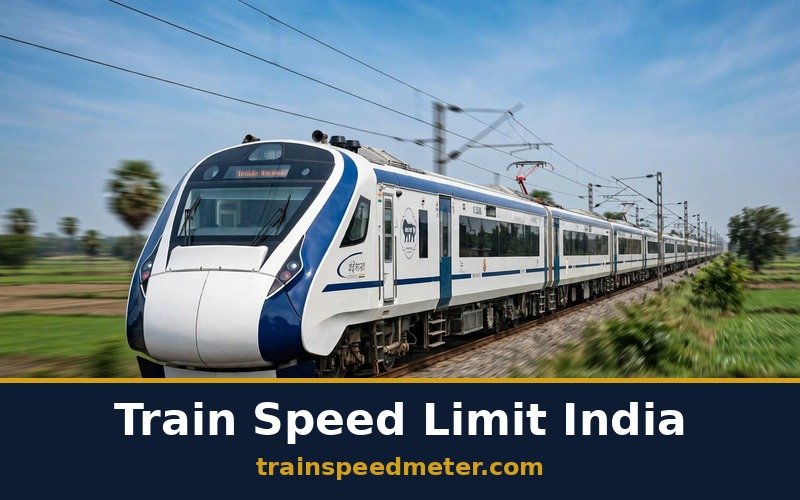
The train speed limit in India depends on the track, signalling and train type. It generally ranges from 100 km/h on suburban lines to 160 km/h on upgraded semi-high-speed sections. The maximum speed of trains in India is 160 km/h, reached by Vande Bharat Express and Gatimaan Express on the Tughlakabad–Agra route. Rajdhani and Shatabdi Express usually top out at 130–140 km/h, and ordinary Mail and Express trains at around 110 km/h.
How the Train Speed Limit in India Is Actually Decided
Indian Railways does not set one national speed limit. Every section of track has its own Maximum Permissible Speed (MPS), also called sectional speed. A train can never legally exceed the lowest of three limits:
The track limit. This depends on rail weight, sleeper type and spacing, curves, gradients, bridges and the condition of the formation.
The rolling stock limit. This is the speed the locomotive, coach or train-set is certified for after trials.
The signalling and safety limit. This covers signal spacing, braking distance, level crossings, station yards and points.
That is why the same Vande Bharat that touches 160 km/h near Agra crawls along at 110 or 130 km/h elsewhere. The train is not the bottleneck. The section is.
Track upgrades are what raise the number on the map. According to data the Ministry of Railways placed before Parliament and published by PIB, the network has changed a lot since 2014:
| Sectional speed | Track km in 2014 | Track km in 2025 |
| Below 110 km/h | 47,897 (60.4%) | 22,862 (21.6%) |
| 110–130 km/h | 26,409 (33.3%) | 59,800 (56.6%) |
| 130 km/h and above | 5,036 (6.3%) | 23,010 (21.8%) |
The upgrades behind these numbers include 60 kg rails, wider-base concrete sleepers, thick-web switches, longer rail panels and modern track maintenance machines. Going past 130 km/h also means straightening curves and reworking overhead equipment, which is why 160 km/h corridors arrive slowly.
Track Groups in Plain Language
Indian Railways groups its broad-gauge lines by the speed they are built for. As summarised on Wikipedia’s high-speed rail in India page, Group A routes support 130–160 km/h, Group B routes 110–130 km/h, and the lower groups (C, D and E) stay below 110 km/h. A route that supports 160–200 km/h is classed as semi-high-speed, and anything below 160 km/h counts as conventional rail.
Maximum Speed of Trains in India by Category
This is the table most readers are really after. These are permissible speeds, not what you will feel on a typical journey.
| Train type | Typical maximum speed | Notes |
| Vande Bharat Express | 130–160 km/h | Designed for 180 km/h; 160 km/h on select upgraded sections |
| Gatimaan Express | 160 km/h | Delhi–Agra stretch |
| Bhopal Shatabdi | 160 km/h | On the Tughlakabad–Agra section |
| Rajdhani / Duronto | 130–140 km/h | Depends on section |
| Shatabdi Express | 130–140 km/h | Introduced in 1988 at 130 km/h |
| Superfast Express | 110–130 km/h | Fewer stops than ordinary Express |
| Mail / Express | Up to 110 km/h | Most common long-distance service |
| Suburban / EMU / local | Around 100 km/h | Average speed is far lower, often near 35 km/h |
| Namo Bharat (RapidX) | 160 km/h operational | 180 km/h design speed |
Vande Bharat Express Speed Limit: Design vs Reality
Vande Bharat is the train most people ask about, and most of the confusion comes from three different numbers.
The design speed is 180 km/h, the speed the train-set is engineered and tested for. The maximum operating speed is 160 km/h, and the Ministry of Railways describes these trains as semi-high-speed services. The permissible speed on a given route is whatever that section allows, which on most routes is 130 km/h or less.
Then there is the average speed, which is the one passengers experience. A Vande Bharat covering a 600 km route in about eight hours averages 75 km/h, no matter how high the peak is. An RTI reply from Madhya Pradesh, reported by the Free Press Journal in 2023, found Vande Bharat trains averaging about 83 km/h against a permissible limit of 130 km/h.
Vande Bharat does not run faster than a Rajdhani on the same track. It accelerates quicker because power is spread across the train-set, and it gets priority and fewer halts. Give an ordinary Express the same priority and the same stops, and the journey time would be much the same.
The first Vande Bharat Sleeper trainset has also been built and has gone through commissioning. Its design speed is 180 km/h, but commercial speed will still follow sectional limits.
Rajdhani and Shatabdi Express Speed
The first Rajdhani flagged off on 1 March 1969 between New Delhi and Howrah, with a top speed of 120 km/h. It covered about 1,450 km in 17 hours 20 minutes, an average of 84 km/h, which was remarkable then. Shatabdi Express arrived in 1988 with a 130 km/h limit.
Today, Rajdhani and Duronto services are permitted 130–140 km/h on the best sections. In practice you will see them settle between 70 and 90 km/h averaged across the whole journey, because of junction slowdowns, signal waits and speed restrictions along the way.
Fastest Train in India Speed: The 160 km/h Club
Only one stretch of Indian track currently supports 160 km/h for passenger trains: the 174 km Tughlakabad–Agra Cantonment section. Gatimaan Express became the country’s fastest commercial train there in April 2016, and Vande Bharat and Bhopal Shatabdi now share that top speed on the same section.
Speed history on Indian rails is worth knowing for context:
Steam locomotives of the WP class reached 100 km/h in 1947.
WAP-1 electric locomotives reached 130 km/h in 1980 and 160 km/h in trials by 1988.
WAP-5 hit 184 km/h in trials in 1997, and WAP-5 hauled a Delhi–Agra train at 160 km/h in 2014.
The 2018 Train 18 (later Vande Bharat) touched 180 km/h in trials.
India has no operational high-speed rail above 200 km/h yet. The Mumbai–Ahmedabad bullet train corridor, about 508 km long, is under construction and expected to open around 2028. Indian-built trains for it are planned at 250 km/h operational speed, and the corridor is designed for higher.
Average Speed of Passenger Trains in India
Passenger trains in India rarely average above 90 km/h, and most run between 55 and 70 km/h. Mail and Express averages moved only from 50.3 km/h in 2017 to 51.1 km/h in 2023, according to figures the Ministry gave Parliament and reported by Newslaundry and IndiaSpend. That happened even though Mission Raftaar, launched in 2017, aimed for 75 km/h.
Why Trains Run Slower Than Their Maximum Speed
If the limit is 130 km/h and the average is 55, the gap has five main causes:
Congestion. Many of India’s busiest routes run beyond rated capacity, so trains wait for a clear path.
Permanent speed restrictions. A 2020 CAG audit found hundreds of permanent restrictions on some zones, with Western Railway at 685 and Southern Railway at 56.
Station and junction layouts. Trains slow for yards and queue outside big stations.
Halts and schedule slack. Timetables include padding for junction delays.
Maintenance windows. Busy lines leave little time for track work, which leads to temporary restrictions.
Experts quoted in the same reporting say raising average speed matters more than raising the maximum. That means fewer halts, grade separation at junctions, and removing slow-down spots.
Rules That Govern Train Speed on the Ground
A few practical rules explain why your train’s speed keeps changing:
Speed boards and signals. Loco pilots follow trackside speed indicators and signal aspects, which vary by section.
Caution orders. Temporary restrictions apply during repair work, flooding or track maintenance.
Curves, bridges and level crossings. All carry lower limits regardless of the line’s MPS.
Station yards and points. Trains take turnouts and crossovers at reduced speed.
Loco and coach certification. A coach rated for 110 km/h will never be run faster, even on a 130 km/h line.
Pro tip from regular travellers: the speed on the cab display is not what you feel. Ride quality changes noticeably around 110 km/h on older stock, and newer train-sets feel steadier at the same speed.
How to Check Your Train’s Live Speed
Timetable averages tell you little about the actual run. A GPS speed meter gives you the real number as you travel. It is free and needs only your phone.
Open the train speed meter in your mobile browser.
Tap Start and allow location access when asked.
Sit near a window with a clear view of the sky.
Read the live km/h figure as the train moves.
In practice, the reading drops to zero inside tunnels and under steel bridges because the GPS signal is lost, then recovers when you come out. For route-specific readings, see the Shatabdi speed test, Vande Bharat speed test and Gatimaan Express speed test.
One correction worth making: some pages list 45–65 km/h as the maximum for Mail and Express trains. That is an average, not the limit. The permitted maximum is up to 110 km/h on most sections.
Train Speed Limit India for Different Travellers
Daily commuters on suburban lines get speeds around 100 km/h at best, but average speeds near 35 km/h because of frequent stops. Frequency matters more than top speed here.
Business travellers on Delhi–Agra or Delhi–Bhopal routes can reach the 160 km/h stretch and save real time on Gatimaan or Vande Bharat.
Long-distance passengers benefit more from punctuality and fewer halts than from peak speed. A Rajdhani at 130 km/h that stops rarely beats a faster train stuck outside junctions.
Railfans and students can use GPS readings to compare timetable claims with real speeds, which makes a good project.
Freight shippers should note that freight speeds are lower still. Mission Raftaar targeted a doubling from 25 to 50 km/h, and dedicated freight corridors aim to clear passenger lines.
What the Train Speed Limit in India Means for Your Next Journey
The train speed limit in India is a map of upgrades, not a single number. Track quality sets the ceiling, and congestion and halts decide where you land beneath it. The 160 km/h Tughlakabad–Agra corridor is the exception today, 130 km/h is the new normal for premium trains, and 110 km/h still covers most Express travel.
For your own trip, check the actual speed with a GPS meter, pick trains with fewer halts, and treat “maximum speed” as a ceiling rather than a promise.
Frequently Asked Questions
What is the maximum speed of trains in India?
The maximum speed of trains in India is 160 km/h. Gatimaan Express, Vande Bharat and Bhopal Shatabdi reach it on the Tughlakabad–Agra section. Most other routes are capped at 110–130 km/h, depending on track and signalling.
What is the Vande Bharat Express speed limit?
Vande Bharat has a design speed of 180 km/h and a maximum operating speed of 160 km/h. On most routes the permitted limit is 130 km/h or lower, and average speeds are often around 75–85 km/h because of stops and track limits.
What is the Indian Railways speed limit per hour for Mail and Express trains?
Mail and Express trains are generally limited to 110 km/h. Superfast Express trains may be allowed up to 130 km/h on upgraded sections. Their real average speed is much lower, usually near 50 km/h.
Which is the fastest train in India by speed?
Gatimaan Express, Vande Bharat and Bhopal Shatabdi share the top operating speed of 160 km/h on the Delhi–Agra stretch. Gatimaan became the country’s fastest commercial train in 2016, and Vande Bharat matches it there.
How fast do Rajdhani and Shatabdi Express run?
Rajdhani and Shatabdi Express are permitted 130–140 km/h on suitable sections. Across a full journey they average roughly 70–90 km/h, since junction delays and speed restrictions pull the figure down.