
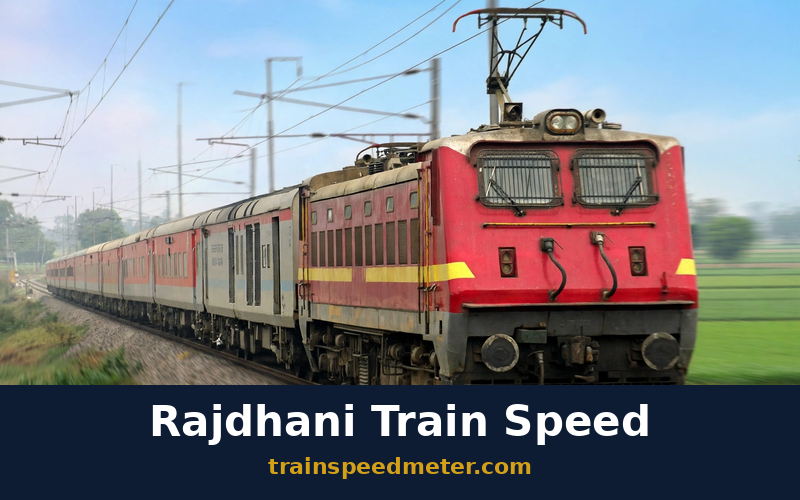
The Rajdhani Express top speed is 130 km/h on most routes. Some outlets cite 140 km/h for the Mumbai-New Delhi Tejas Rajdhani, the fastest Rajdhani in India. In daily service, though, trains run slower. Scheduled averages range from about 58 km/h on Northeast routes to roughly 88 km/h on the Mumbai corridor. The maximum speed is a permitted ceiling, not a cruising figure..
What “Top Speed” Actually Means for a Rajdhani
Ask ten people how fast a Rajdhani runs and you’ll hear ten numbers. They’re usually all correct, because they describe different things.
Maximum permissible speed is the highest speed a train is allowed to touch on a given section. It depends on the track, the signalling, the curves and the rolling stock. For most Rajdhani services this is 130 km/h.
Average (commercial) speed is total distance divided by total scheduled time, halts included. This is the number that decides when you reach your destination.
Operating speed sits in between. It’s what the loco pilot actually holds on a clear stretch, often 110 to 130 km/h.
Most confusion on the web comes from mixing these three. Railzi’s network summary lists 89 km/h as the “top speed,” but that’s the fastest average scheduled speed on the Mumbai Central–New Delhi run. It isn’t a speedometer reading.
The Rajdhani Express Speed Limit: 130 km/h in Practice
A Rajdhani is built for more than it’s allowed to do. According to the Rajdhani Express page on Wikipedia, the trains are capable of higher speeds, but the maximum is generally held at 130 km/h. Average speeds are much lower because of traffic and track limits.
The 130 km/h ceiling applies to nearly every pair, with two exceptions. Both Dibrugarh Rajdhani services that run through Assam, via Rangapara North and via Moranhat, are listed at 110 km/h.
Rajdhani trains are usually hauled by WAP-7 or WAP-5 electric locomotives and run on LHB coaches. Both are certified for speeds well above the limit these routes allow. The limit comes from the infrastructure, not the train.
Is 140 km/h Correct? Clearing Up the Mumbai Tejas Rajdhani Number
Several news outlets, including the Financial Express and India.com, report that the Mumbai–New Delhi Tejas Rajdhani (12951/12952) has a maximum permissible speed of 140 km/h. Wikipedia’s service table lists it at 130 km/h.
Both figures circulate because sectional limits change as tracks are upgraded and as sections of the Delhi–Mumbai corridor are certified. The safest reading is this: 130 km/h is the standard Rajdhani ceiling, and 140 km/h is the figure reported for the Mumbai route on upgraded sections. For any exact figure on a specific date, check the working timetable or the Indian Railways official portal.
The Fastest Rajdhani Express in India
The Mumbai Tejas Rajdhani Express is the fastest Rajdhani on both counts: the highest reported speed ceiling and the best average. It has run since 1972 and today runs daily between Mumbai Central and New Delhi.
Distance: about 1,386 km
Scheduled time: 15 hours 32 minutes
Average speed: roughly 88 to 89 km/h
Halts: six, at Borivali, Surat, Vadodara, Ratlam, Nagda and Kota
Rake: Tejas-style LHB coaches
On the published schedule, 12951 leaves Mumbai Central at 17:00 and reaches New Delhi at 08:32. The return train, 12952, leaves New Delhi at 16:55 and arrives in Mumbai Central at 08:35. Timings get revised, so confirm the Rajdhani Express time table on the Indian Railways portal before you book.
In practice, this is the route where the train gets to stretch its legs. The gaps between halts are long, the track is among the best-maintained on the network, and the Rajdhani gets priority over almost everything else.
Rajdhani Express Average Speed: Route-by-Route Comparison
Average speed is where Rajdhanis differ most. Figures below are from the service table on Wikipedia, rounded.
| Rajdhani service | Distance | Scheduled time | Max speed | Avg speed |
| Mumbai Central–New Delhi (Tejas) | 1,386 km | 15h 32m | 130 km/h* | ~88 km/h |
| Howrah–New Delhi (via Gaya) | 1,451 km | 17h 15m | 130 km/h | ~84 km/h |
| Mumbai CSMT–Hazrat Nizamuddin | 1,537 km | 17h 55m | 130 km/h | ~84 km/h |
| August Kranti (Mumbai Central–Nizamuddin) | 1,378 km | 16h 33m | 130 km/h | ~82 km/h |
| Sealdah–New Delhi | 1,458 km | 18h 00m | 130 km/h | ~81 km/h |
| Patna (Rajendra Nagar)–New Delhi | 1,001 km | 12h 30m | 130 km/h | ~80 km/h |
| KSR Bengaluru–Hazrat Nizamuddin | 2,367 km | 33h 30m | 130 km/h | ~71 km/h |
| Thiruvananthapuram–Hazrat Nizamuddin | 2,844 km | 41h 15m | 130 km/h | ~69 km/h |
| Dibrugarh–New Delhi (via Rangapara North) | 2,294 km | 39h 38m | 110 km/h | ~58 km/h |
| Sairang–Anand Vihar Terminal | 2,510 km | 42h 15m | 130 km/h | ~58 km/h |
*Some outlets report 140 km/h for this service.
The pattern is clear. The Mumbai and Howrah corridors, built for heavy, fast traffic, produce the highest averages. Southern and Northeast routes run through more single-line sections, more curves and more mixed traffic, which pulls the average down even with the same 130 km/h ceiling.
An older benchmark shows how much schedules shift. IIT Delhi’s list of India’s fastest trains, last updated in 2015, put the Mumbai Rajdhani at a commercial speed of 86.05 km/h, the top spot at that time. The Howrah Rajdhani used to cover its route at around 86 km/h between 2006 and 2016 before the schedule was stretched by 15 minutes for safety and operational reasons, as Wikipedia records.
Why a Rajdhani Never Runs at Top Speed All the Way
A 130 km/h train covering 1,386 km should take about 10 hours and 40 minutes. The actual run takes nearly 16. Where does the time go?
Speed restrictions
Curves, bridges, level crossings and yard approaches force the train down to 100, 80 or even 15 km/h for stretches.
Halts
Each stop costs the time it takes to brake, stand and accelerate again, usually 8 to 12 minutes in total.
Mixed traffic
Even a priority train waits at signals when a section is congested.
Maintenance blocks and caution orders
Track work forces temporary slowdowns.
Station-area limits
Entering Delhi, Mumbai or Howrah means crawling through crowded terminal approaches.
If you’ve ever watched a speedometer app on a Rajdhani, you’ll have seen the pattern: 110 to 130 km/h for long stretches, then a sharp fall near a station, then a slow climb back. The ceiling is reached, but never held for long.
How to Calculate a Train’s Average Speed Yourself
You don’t need special data. Anyone can do this with a ticket and a timetable.
- Find the train’s total route distance in kilometres. Use the chargeable distance on your ticket or the official timetable.
- Note the scheduled departure and arrival times, including the date change for overnight trains.
- Convert the total journey time into hours. For example, 15 hours 32 minutes is 15.53 hours.
- Divide distance by hours: 1,386 ÷ 15.53 ≈ 89 km/h.
- Compare the result with the published maximum. The gap between the two shows how much time the route loses to halts and restrictions.
One caution: some routes, such as the Konkan section, publish a chargeable distance higher than the real distance. IIT Delhi’s list flags this, so speeds on those routes can look better on paper than they are.
How to Check Your Rajdhani’s Live Speed on Board
If you want the real number rather than the brochure number, a GPS-based speedometer on your phone is the easiest route.
- Sit by a window or in a spot with good signal. Metal-roofed coaches can weaken GPS.
- Open a train speed meter and let it lock on before the train picks up pace.
- Note the speed on open stretches, not near stations or junctions.
- Compare readings at different times, since speeds vary a lot between sections.
Expect the reading to move constantly. The highest steady reading you’ll typically see on a Rajdhani is 120 to 130 km/h. Readings above that on a standard Rajdhani are a sign the GPS is spiking, not the train.
Rajdhani vs Shatabdi Speed and Other Fast Trains
Rajdhanis aren’t the fastest trains in India on paper. They’re the premium long-distance option, built for overnight comfort rather than raw pace.
| Train type | Typical max speed | Best-known average speed | Typical use |
| Rajdhani | 130 km/h (some routes 110) | up to ~88 km/h | Overnight, Delhi to state capitals |
| Shatabdi | 130 to 150 km/h | ~72 to 84 km/h | Day trips under ~1,000 km |
| Duronto | 130 km/h | ~70 to 85 km/h | Non-stop or few-stop long runs |
| Gatimaan Express | 160 km/h | Delhi–Agra corridor | Fast day return |
| Vande Bharat | 160 km/h in service (180 design) | Varies by route | Intercity day services |
Maximum speeds above are the commonly reported permissible figures and vary by section. Compare these with the live readings on the Shatabdi speed test, Gatimaan speed test and Vande Bharat speed test pages.
The takeaway: a Shatabdi or Gatimaan can touch higher speeds, and a Vande Bharat accelerates faster, but on long overnight sectors the Rajdhani’s priority status and few halts keep its average competitive. The fastest train in India by commercial speed has traditionally been a Rajdhani or Duronto on the Delhi corridors, as IIT Delhi’s ranking shows. That is a different measure from the fastest train on paper.
Rajdhani Rolling Stock: What Shapes Its Speed
Locomotives
WAP-7 and WAP-5 electric locomotives pull most Rajdhanis today. Older services once used diesel units like the WDM-2 and WDP-4, which is one reason early speeds were lower.
Coaches
LHB coaches replaced the older ICF design starting in 2003 on the Mumbai Rajdhani. They’re built for safe running at 160 km/h and give a steadier ride at speed.
Tejas rakes
From July 2021, Indian Railways began upgrading Rajdhani rakes to Tejas-style coaches with air suspension, automatic doors, CCTV and Wi-Fi. The change improves comfort and safety, but speed is still set by the track.
Who Needs to Know the Rajdhani Top Speed?
Regular travellers care about average speed and the time table, since those decide arrival time and connections.
Railfans and photographers want the permissible speed and the long non-stop sections, which is where the train is moving fastest.
Students preparing for railway exams need the clean distinctions: top speed, average speed, and the fastest Rajdhani by route.
Content creators and bloggers should quote the speed with its source, since figures differ between Indian Railways, Wikipedia and news outlets.
Business travellers comparing the Rajdhani with a Vande Bharat or a flight should weigh the door-to-door time, including overnight sleep, against pure speed.
Pro Tips From Frequent Rajdhani Travellers
- Quote speed with its type. “130 km/h permissible, 88 km/h average” is accurate. “130 km/h” alone is incomplete.
- Pick the Mumbai Tejas Rajdhani if you want the quickest Rajdhani journey on the network.
- Check the time table close to travel. Schedules change after track work and summer timetable revisions.
- For live speed, trust readings taken on open stretches and ignore short spikes.
- Booking is dynamic: Rajdhani fares move with demand, so the same berth can cost very different amounts across dates.
Rajdhani Top Speed: The Short Version for Quick Reference
The Rajdhani top speed is 130 km/h on nearly every route, with 140 km/h reported on the Mumbai–New Delhi service. What passengers actually experience is an average of 58 to 88 km/h, shaped by halts, curves and traffic. The Mumbai Tejas Rajdhani remains the fastest of the family, and for a faster ceiling you’d move to a Gatimaan or Vande Bharat. For everything else about how fast a train really runs, see the speed tests on Train Speed Meter.
FAQs
What is the top speed of Rajdhani Express?
The top speed of Rajdhani Express is 130 km/h on most routes. The Mumbai–New Delhi Tejas Rajdhani is reported at 140 km/h by some outlets. Two Dibrugarh services via Assam are limited to 110 km/h. These are permitted maximums, not sustained running speeds.
Which is the fastest Rajdhani Express in India?
The Mumbai Tejas Rajdhani Express (12951/12952) is the fastest. It covers about 1,386 km in 15 hours 32 minutes with six halts, giving an average near 88 km/h, the best among all Rajdhani services on the network.
What is the Rajdhani Express average speed?
Average speed ranges from about 58 km/h to 88 km/h depending on route. Mumbai and Howrah corridors sit at the top, with 80 to 88 km/h. Long routes to the South and Northeast average 58 to 71 km/h because of more curves and mixed traffic.
Is Rajdhani faster than Shatabdi?
Not on paper. Shatabdi routes are permitted 130 to 150 km/h, while Rajdhani is mostly 130 km/h. But on long overnight sectors with few halts, a Rajdhani can match or beat a Shatabdi’s average speed, which is why the comparison depends on the route.
What is the Rajdhani Express maximum speed in km/h and mph?
130 km/h, which is roughly 81 mph. On the Mumbai Tejas Rajdhani, some sources quote 140 km/h, around 87 mph. Average scheduled speeds are lower, typically 58 to 88 km/h, or about 36 to 55 mph.