
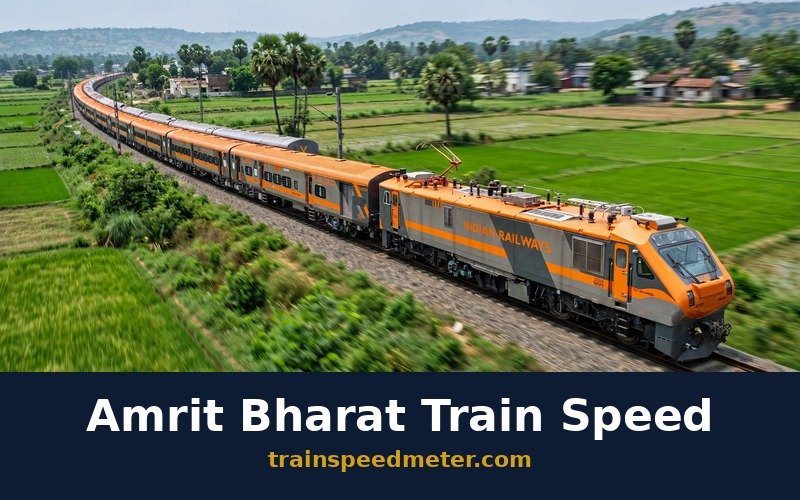
Amrit Bharat train speed peaks at 130 km/h in regular service, against a design speed of 160 km/h. The Amrit Bharat Express is a non-AC superfast train with sleeper and general coaches. It runs push-pull, with a locomotive at each end, so it picks up speed quickly. Real average speeds are lower, roughly 36 to 69 km/h depending on the route, because of stops, track limits and traffic. Mumbai LTT–Prayagraj has the fastest scheduled average.
How Fast Is the Amrit Bharat Express?
Three numbers get mixed up in most articles on this train, so it helps to separate them.
Maximum operating speed: 110 to 130 km/h, depending on the route and the track it runs on.
Design speed: 160 km/h. This is what the trainset is engineered to handle, not what passengers experience.
Average scheduled speed: the distance divided by the total journey time, stops included. This is the number that decides when you actually arrive.
According to the Amrit Bharat Express entry on Wikipedia, the trainset runs on 1,676 mm broad gauge under 25 kV AC overhead electrification. Most services are cleared for 130 km/h, but a few, such as Darbhanga–Gomti Nagar, are listed at 110 km/h.
Acceleration: why the push-pull setup matters
Commonly cited figures put 0 to 130 km/h at roughly three minutes. Other comparison pieces describe a smooth start of two to three minutes. With locomotives at both ends, the train gets pulling and pushing force together. That means quicker recovery after every stop and slow-down, which matters on a route with 20 or 30 halts.
Why the Average Speed Is Much Lower Than 130 km/h
A train that is allowed 130 km/h rarely holds it for long. Four things pull the average down:
Stops. Many Amrit Bharat services make 20 to 40 halts. Each one costs the stopping time plus the braking and acceleration on either side.
Track speed limits. The sectional speed on much of the network is below 130 km/h, however fast the train can go.
Mixed traffic. Passenger, goods and other express trains share many corridors, so Amrit Bharat sometimes waits for a clear path.
Route length. On journeys of 2,000 to 3,000 km, small delays pile up across several states.
Indian Railways trains do not run at full speed all day. The headline number is a ceiling, and the average is the truth.
Amrit Bharat Express Average Speed by Route
The table below uses published schedules for a spread of routes, from the fastest to some of the slowest. Timings are revised from time to time, so treat them as a guide and check the current timetable before you travel.
| Route | Distance | Journey time | Max speed | Average speed |
| Mumbai LTT–Prayagraj | 1,342 km | 19h 20m | 130 km/h | 69 km/h |
| Banaras–Sealdah (Kolkata) | 772 km | 11h 50m | 130 km/h | 65 km/h |
| Prayagraj–Udhna (Surat) | 1,440 km | 22h 45m | 130 km/h | 63 km/h |
| Rajendra Nagar (Patna)–New Delhi | 999 km | 16h 35m | 130 km/h | 60 km/h |
| Nagercoil–New Jalpaiguri | 3,102 km | 54h 00m | 130 km/h | 57 km/h |
| Darbhanga–Anand Vihar (Delhi) | 1,137 km | 20h 40m | 130 km/h | 55 km/h |
| Erode–Jogbani | 3,129 km | 58h 50m | 110 km/h | 53 km/h |
| Malda Town–SMVT Bengaluru | 2,272 km | 45h 10m | 130 km/h | 50 km/h |
| Darbhanga–Gomti Nagar (Lucknow) | 629 km | 14h 35m | 110 km/h | 43 km/h |
| Chhapra–Anand Vihar (Delhi) | 949 km | 24h 10m | 130 km/h | 39 km/h |
What the numbers tell you: The fastest averages go to routes with few halts. Mumbai LTT–Prayagraj makes just seven stops on a 1,342 km run. The slow averages belong to routes that serve many smaller towns or share busy, congested sections. The rake is the same in every case, so the route decides the speed.
How Push-Pull Technology Works
The Amrit Bharat rake is not a self-propelled unit like a metro. It is a locomotive-hauled train with a WAP-5 or WAP-7 electric locomotive at each end, usually finished in orange and dark grey. Both locomotives are driven from one cab, so the driver controls the whole train at once.
This design brings three practical benefits:
No engine change at terminals. The train can reverse without shunting a locomotive around.
Strong, balanced traction. Combined output is around 12,000 HP in the dual-WAP-5 configuration, which gives the quick pickup mentioned earlier.
Smoother running. The coaches use a semi-permanent coupler, which reduces the jerks you feel in older ICF rakes when the train starts or brakes.
Not every run uses two locomotives. In 2026 the Tiruchchirappalli–New Jalpaiguri Amrit Bharat Express ran with a single WAP-7 for the first time, without push-pull. The railway is clearly testing how much of the push-pull advantage is needed on each route.
Amrit Bharat vs Vande Bharat vs Namo Bharat
This is the comparison most readers search for. The three trains serve different needs, and speed is only part of the story.
| Feature | Amrit Bharat Express | Vande Bharat Express | Namo Bharat Rapid Rail |
| Train type | Locomotive-hauled, push-pull | Self-propelled trainset | Self-propelled regional trainset |
| Max operating speed | 110–130 km/h | Up to 160 km/h | Up to 160 km/h |
| Design speed | 160 km/h | 160 km/h and above | 180 km/h |
| 0–100 km/h | About 2–3 minutes (push-pull start) | About 52 seconds | About 55 seconds |
| Classes | Non-AC sleeper and general | AC chair car, executive class | AC premium and standard |
| Best for | Long-distance, budget travel | Medium-to-long inter-city travel | Short regional commutes (100–250 km) |
| Fare level | Lowest of the three | Highest of the three | Moderate, commuter-based |
If speed is your only priority, Vande Bharat and Namo Bharat win on paper. But the gap shrinks on long routes, where stops and track limits cap every train. For a family that wants a faster, cleaner non-AC journey at an ordinary fare, Amrit Bharat is in a class of its own. You can see how the faster trains behave on the ground in the Vande Bharat speed test, the Shatabdi speed test and the Gatimaan speed test.
Amrit Bharat Express Route and Timetable
The first two services were flagged off on 30 December 2023 (Darbhanga–Anand Vihar and Malda Town–SMVT Bengaluru), and the train entered commercial service on 1 January 2024. It is meant for cities more than 800 km apart or journeys that take over ten hours. Since then the network has grown to more than 40 route pairs, and each service has a matching return train in the opposite direction.
Most services run weekly, though some are daily or bi-weekly. Hubs such as Delhi, Hyderabad (Charlapalli) and Mumbai LTT have the most services.
A worked example: 13433 SMVT Bengaluru–Malda Town
This long-haul run shows how the timetable behaves in practice:
Departure: 13:50 on day one from SMVT Bengaluru
Arrival: 09:15 on day three at Malda Town
Distance: about 2,264 km through four states
Halts: 34, including Katpadi, Renigunta, Vijayawada, Rajahmundry, Visakhapatnam, Bhubaneswar, Cuttack, Kharagpur, Barddhaman and New Farakka
Average speed: about 52 km/h
Notice that the average is well below 130 km/h, even though the train is allowed to hit that figure. Always confirm the running days and timings on the Indian Railways site at indianrail.gov.in before you book, as schedules are revised.
Amrit Bharat Express Coaches and Features
A full rake has 22 coaches, split into 20 for passengers (sleeper and general unreserved) and two for parcels. The trainsets are built at the Integral Coach Factory in Chennai at around ₹65 crore each.
Onboard features include:
Charging points and reading lights in the berths
CCTV cameras
Bio-vacuum toilets
Sensor-based water taps
A passenger information system
A semi-permanent coupler for a smoother ride
In January 2025 the Ministry of Railways added twelve improvements in the Amrit Bharat 2.0 version, including modular toilets and an emergency braking system. If you are choosing between a new rake and an older ICF train on the same route, the newer rake is the better bet for comfort.
How the Non-AC Sleeper Feels at Speed
Speed in a non-AC sleeper behaves differently than in an AC train. Windows are open or semi-open, so you hear more wind and track noise when the train is near 130 km/h. In practice, the semi-permanent coupler does take away much of the sudden jolting at starts and stops, and the ride feels steadier than in older rakes.
Overnight sections are where the train does its best running. With fewer stops after dark, it holds higher speeds for longer, and that is where much of the schedule is won.
How to Check the Real Speed of Your Train
The timetable gives an average, but you may want to know how fast the train is actually moving. A GPS speed meter does this without a mobile signal. The steps are simple:
Open a GPS-based speed meter such as the one at Train Speed Meter.
Sit near a window so the phone has a clear view of the sky.
Wait for the GPS lock before you read the number.
Compare the reading with the 110–130 km/h limit for your route.
If you want to understand how this works offline, see the guide on testing train speed without internet.
Who Should Take the Amrit Bharat Express
Budget travellers: fares are kept close to ordinary non-AC fares.
Migrant workers and students: long-distance journeys with a cleaner, more modern coach.
Families on 800+ km routes: a more comfortable alternative to older sleeper trains.
Rail enthusiasts: the push-pull setup and 130 km/h running make it interesting to ride.
Pro Tips Before You Book
Check the average speed, not the top speed. Compare journey times across trains on your route.
Book early. Weekly services fill quickly because there is only one train a week.
Look at the halt count. Fewer stops usually mean a faster run.
Note the running days. Many services do not run daily.
Honest Limits to Keep in Mind
The Amrit Bharat Express has real limits, and a fair guide should say so. It is not a high-speed train. Its average is held down by the network it runs on, and some routes with many halts feel slow. There are no AC coaches and no automatic doors, and crowding in general coaches remains a real issue on popular routes. Think of it as a better non-AC train, not a faster Vande Bharat.
Frequently Asked Questions
What is the maximum speed of the Amrit Bharat Express?
The maximum operating speed is 130 km/h on most routes, with some limited to 110 km/h. The trainset is designed for 160 km/h, but that is an engineering figure. Passengers get the operating speed, which depends on the track.
What is the Amrit Bharat train average speed?
Average speed depends on the route. The fastest services, such as Mumbai LTT–Prayagraj, average around 69 km/h, while slower regional timings fall near 36 to 43 km/h. Most long-distance services land between 50 and 60 km/h once stops are included.
Is Amrit Bharat faster than Vande Bharat?
No. Vande Bharat is cleared for up to 160 km/h and accelerates faster. Amrit Bharat tops out at 130 km/h. On long routes with many stops, the real journey-time difference is smaller than the top-speed gap suggests.
Why does Amrit Bharat have engines at both ends?
It uses push-pull technology, with a locomotive at the front and one at the rear. Together they give strong, balanced traction and quicker acceleration, and the train can reverse at terminals without changing engines.
Does the Amrit Bharat Express have AC coaches?
No. It offers non-AC sleeper and general unreserved coaches. It is designed as a low-cost option for long journeys, and anyone who wants air conditioning needs to look at other trains.