
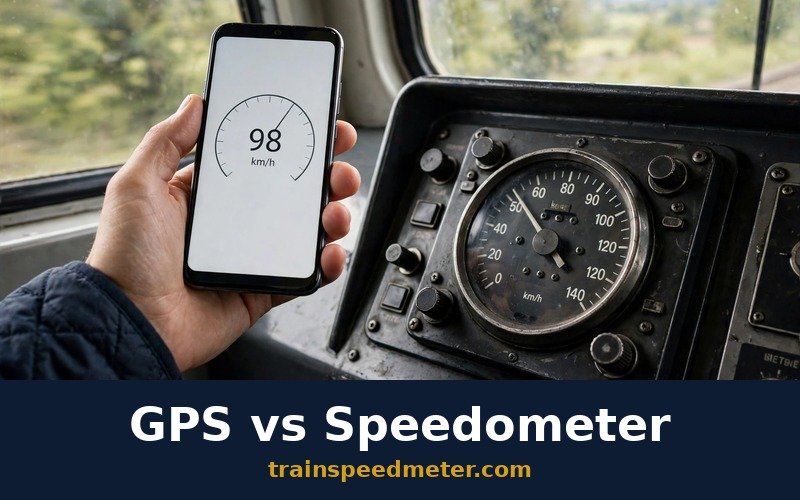
GPS vs. speedometer comes down to two different measurement methods. A GPS receiver calculates speed from satellite signals, so it is usually the more accurate reading on open, steady roads. A car speedometer counts wheel rotations and is deliberately calibrated to read slightly high, often by 2–10%. That is why the dashboard and your phone rarely agree, and why a small gap is normal.
How a Car Speedometer Actually Works
Your speedometer never measures speed directly. A sensor on the transmission or at each wheel counts rotations, and the car’s computer multiplies that count by an assumed tire circumference to get distance per second. The result is the number behind the needle.
Everything depends on that assumed circumference. The system believes your tires are the factory size and the factory condition. Change either one and the maths drifts, even though the sensor itself is working perfectly.
Older cars used a flexible cable spinning inside a sheath, with a magnet dragging a needle against a spring. Modern cars use electronic pulses instead. The principle is the same, and so are the weak points.
How GPS Measures Speed
A GPS receiver listens to signals from several satellites at once. It works out its position from the signal travel times, and it works out speed in two ways.
The simple method is distance over time: where were you a moment ago, where are you now. The better method uses the Doppler effect. Your motion slightly shifts the frequency of each satellite’s signal, and the receiver reads that shift directly. According to the performance standard published on GPS.gov, the government-run GPS system delivers speed accuracy of a few millimetres per second under good conditions. Your phone’s reading will not match that, but the underlying signal is that precise.
GPS knows nothing about your tires, your gearbox, or your wheel size. It only knows how fast the antenna is moving over the ground, which is the same principle that lets you measure train speed with GPS from a window seat.
Why Your Speedometer and GPS Show Different Speeds
If you have wondered why your speedometer is different from GPS, there are four common reasons, and they often stack.
The manufacturer deliberately reads high
Most regions require that a speedometer never under-reads. The UN’s Regulation 39, which many countries follow, says the indicated speed must never be below the true speed and must not exceed 110% of true speed plus 4 km/h. At a true 80 km/h, the dash may legally show anywhere from 80 to 92 km/h. A summary of these rules sits on the Wikipedia speedometer page.
Car makers aim for the safe side because an under-reading dash would put every owner at risk of a ticket they could blame on the car. Australian rules take the same approach. The United States has no single passenger-car rule written the same way, but cars sold worldwide are generally built to the stricter standard.
In practice, this is the main reason for the gap. Most cars we check against GPS show a consistent over-read that grows slightly with speed.
Tire size changes the maths
Larger tires cover more road per rotation. If your tires are 3% larger in diameter than the car expects, the speedometer under-reports by about 3%, and your true speed at an indicated 100 km/h is closer to 103.
Here is a worked example. A 205/55 R16 tire has a diameter of about 632 mm. Swap to a 205/60 R16 and the diameter becomes about 652 mm, roughly 3.2% bigger. The car still thinks it has the old tire, so it under-reports by that margin. Lift kits, off-road tires and “plus-sizing” wheels cause the largest errors.
Tire wear shrinks the wheel
As tread wears away, the tire’s rolling diameter falls by a few percent over its life. A smaller wheel turns more times per kilometre, so the speedometer reads higher than before. Tire pressure matters too. A soft tire has a slightly smaller rolling radius.
GPS has its own weaknesses
GPS is not perfect either. Phone receivers average readings over a short window, so during hard acceleration or braking, the display can lag behind by a second or two. Tunnels, parking structures, and tall buildings block or bounce signals. Thick tree cover and deep valleys can weaken them. A cheap or badly placed receiver can also show speed spikes when it momentarily loses its fix.
GPS Speed vs Actual Speed: What the Difference Really Means
When people compare GPS speed and actual speed, they are really asking which source is closest to the truth. On a straight, open road at a steady pace, or a long open rail stretch like the ones in our Shatabdi speed test, GPS is the closest thing most people can access. The reading reflects motion over the ground and ignores tire size, tire wear, and factory padding.
That does not make it infallible. Over short intervals, a phone’s reading can jump or lag. For a trustworthy comparison, you need a steady speed held for long enough that both systems settle.
GPS Speed vs Speedometer Accuracy: Side-by-Side Comparison
| Factor | Car speedometer | GPS speed |
| Measurement method | Wheel or transmission rotation | Satellite signal (Doppler and position) |
| Typical error | Reads 2–10% high, by design | Very small in open sky |
| Affected by tire size | Yes | No |
| Affected by tire wear | Yes | No |
| Reaction to sudden speed changes | Near-instant | Can lag 1–2 seconds |
| Works in tunnels and garages | Yes | Often drops out |
| Best for | Staying legal, short-term changes | True speed, long steady stretches |
| Needs calibration | Yes, after tire changes | No |
Which One Should You Trust?
Trust the GPS when you want to know your real speed. That means fuel-economy tests, checking your cruise control, logging a trip or confirming how far off your dash is.
Trust your speedometer for day-to-day driving, particularly in traffic, in tunnels and anywhere the GPS signal is poor. Because it reads high, it keeps you a few kilometres per hour below the limit. A fixed enforcement camera or police radar measures your true speed, so an over-reading dashboard works in your favour.
Many drivers find the best approach is to learn their car’s error once and then use the dash with that adjustment in mind.
How Accurate Is a Car Speedometer?
A typical modern car overstates speed by 2–6%. At 100 km/h indicated, the true speed is often 95–98 km/h. Some cars are almost spot on, and a few older or heavily modified vehicles are off by far more.
Three details help you judge your own car:
- The error usually grows with speed. Many cars read almost correct at 40 km/h and 5–6 km/h high at 120.
- The error is rarely random. If it changes wildly from one drive to the next, something is wrong with a sensor or wiring.
- A reading that is too low is a red flag. Because of the legal rule, a dash showing less than your true speed usually means non-standard tires or a faulty component.
How to Check Your Speedometer Against GPS (Step by Step)
You do not need special equipment. A phone with a good GPS app and a passenger to watch it will do.
- Pick the right road. Choose a long, straight, flat stretch with a clear view of the sky, away from tall buildings and tunnels.
- Check tire pressure first. Set pressures to the number on the door-jamb placard so tires are at their normal rolling size.
- Set the same units. Make sure the dash and the app both use km/h or both use mph.
- Hold a steady speed. Use cruise control if you have it. Hold the dash at 60, then 80, then 100 km/h for at least 30 seconds each.
- Let the phone settle. Wait several seconds after reaching each speed before you take a reading. A passenger should record it, not the driver.
- Repeat in the opposite direction. Drive the same road both ways to cancel out slope and any signal quirks.
- Write the numbers down. Compare the dash value to GPS at each speed. You now have your car’s real error curve.
Speedometer Calibration: When You Need It
Most drivers never need speedometer calibration. If the dash reads 3–5% high and nothing has changed, you are in the normal range.
Calibration makes sense when:
- You fitted larger or smaller tires or wheels than the factory size
- The gap exceeds about 10%, or the dash reads below true speed
- You need an accurate odometer for a lease return or a commercial vehicle
- You use the vehicle for work, such as delivery, where speed or mileage is logged
On older cars, adjusting the speedometer drive gear or fitting an inline signal converter is common. On modern cars, a workshop reprograms the tire-circumference value in the control unit using manufacturer or specialist tools. Consumer OBD2 readers can usually display the speed signal but cannot always rewrite it. Ask a workshop what your car supports before you buy anything.
Real-World Examples
The highway cruise. You set cruise control to 110 km/h on the dash, and your phone reads 105. That 5 km/h gap, about 4.5%, is typical and requires no action.
The winter tire swap. A driver fits winter tires of the nominal same size, and suddenly the gap widens. Different brands vary by a couple of percent in actual diameter, so the same size label can produce a different speedometer error.
The lifted truck. A pickup with oversized off-road tires shows 100 km/h while GPS reports 108. The tires are larger, the truck is faster than the dash says, and the owner is at real risk of a ticket.
The tunnel. A phone shows 0 km/h in a long tunnel, or freezes at the last reading. The dash keeps working because it never depended on satellites.
Pro Tips From Actual Use
- Use a phone mount with a clear view of the sky. A phone in a dashboard cubby or glove box can lose its fix. Near the windscreen is best.
- Compare at a steady speed, not during acceleration. Most “big gaps” people report are timing lag, not error. Rail readings behave the same way, which you can see in our Gatimaan speed test.
- Record two or three speeds. A single comparison hides the way error grows with speed.
- Check after any tire change. It takes ten minutes and can save you a ticket.
- A dedicated GPS unit beats a phone for logging. Receivers that update five or ten times per second respond faster than the one-per-second phone standard.
Use Cases: Who Should Trust What
Everyday drivers: Rely on the dash and learn its offset. It is fine for staying within limits.
Fuel-economy trackers and road-trippers: Use GPS for distance and average speed, since it ignores tire-size errors.
Truck, van and fleet operators: Use GPS or a calibrated telematics unit. Dash error on a loaded, re-tired vehicle can distort mileage and compliance records.
Motorcyclists: The same rules apply, but tire changes have a larger effect because bike tires have a more rounded profile. GPS gives a cleaner reference.
Rail enthusiasts and travellers: GPS is the standard tool here. Trains have no passenger speedometer, and railway speed data is hard to get from the cab. Our Vande Bharat speed test shows how GPS readings from a window seat compare against published top speeds. Trains face their own wheel-wear issue, because steel wheels are turned down over time, which changes their diameter and affects axle-based speed sensors.
Common Mistakes When Comparing GPS and Speedometer
- Comparing speeds while accelerating, braking, or climbing a hill
- Mixing miles per hour and kilometres per hour
- Judging the reading from a phone that has just started and has not locked onto satellites
- Taking a maximum or “peak” GPS reading as the true speed, when spikes can occur
- Assuming a gap of a few percent means the speedometer is broken
- Forgetting that tire pressure and load change rolling diameter
When a Speed Gap Signals a Real Problem
A steady over-read of a few percent is normal. Get the car checked if you notice any of these:
- A needle that jumps, sticks, or bounces at constant speed
- The dash reading below GPS, with unchanged tires
- A difference above about 10% at highway speed
- Warning lights appearing alongside speedometer trouble
- A sudden change in the gap after service work
The usual culprits are a failing wheel-speed sensor, damaged wiring, or an incorrect tire-size setting after a software update.
GPS vs Speedometer: The Bottom Line
The question of GPS vs speedometer has a clear answer for most drivers. GPS wins on truth, because it measures motion over the ground and ignores your tires. The speedometer wins on reliability and legal safety, because it keeps working in tunnels and errs on the high side. If you want your real speed, use GPS on open road. If you want to stay out of trouble in everyday driving, follow the dash and keep its known offset in mind.
Frequently Asked Questions
Is GPS more accurate than a speedometer?
In open conditions, yes. GPS measures movement over the ground and does not depend on tire size or wear. A speedometer counts wheel rotations and is deliberately set to read high. GPS can still lag or drop out in tunnels, dense cities and thick cover, where the speedometer is more dependable.
Why is my speedometer different from GPS?
The two methods differ at the source. Your dash infers speed from wheel rotation and an assumed tire size, and manufacturers add a safety margin so it never under-reads. GPS tracks satellite signals. Tire wear, wheel changes, units, and reception all widen the gap further.
How accurate is a car speedometer?
Most are within 2–6% high. At 100 km/h indicated, your true speed is typically 94–98 km/h. Regulations allow up to 10% plus 4 km/h of over-reading, and error often grows at higher speeds. A speedometer reading below true speed usually points to non-standard tires or a fault.
Is it normal for my speedometer to read higher than GPS?
Yes. A few kilometres per hour above GPS is the expected pattern, because makers calibrate dashboards to err on the high side. A gap around 3–5% is nothing to worry about. A difference above 10%, or one that fluctuates, deserves a workshop check.
Does tire size affect speedometer accuracy?
Yes, significantly. A tire 3% larger in diameter makes the dash under-read by roughly 3%, so you travel faster than shown. Smaller tires cause the opposite. Worn tires have a smaller rolling diameter, which slowly makes the speedometer read higher over their lifespan.