
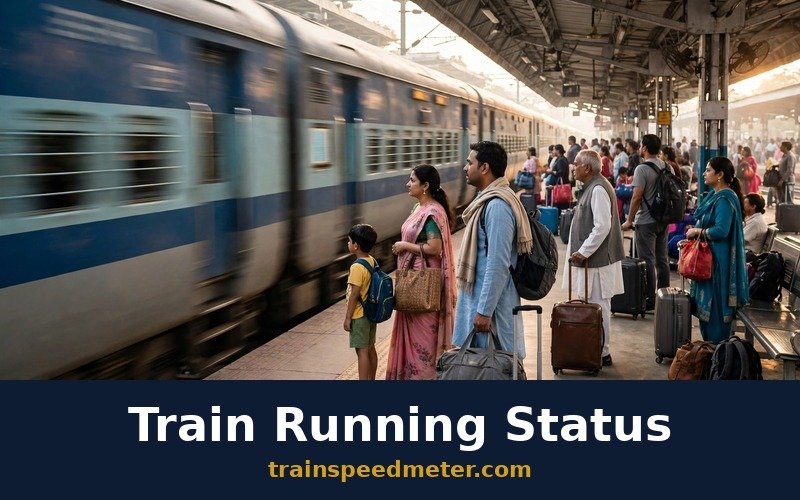
Train running status is the live record of where a train is right now, how many minutes it is running late, and when it will reach each upcoming station. You can check live train running status by entering a train number on the NTES website or in a tracking app. The result shows the last crossed station, expected arrival and departure times, and platform number, so you can time your trip to the station and avoid long waits.
What Train Running Status Actually Tells You
Most people open a status page for one reason: to find out whether the train is late. But a proper running status screen carries far more than a single delay number.
Here is what you will normally see:
- Current position: the station the train last crossed, or the section between two stations where it is now.
- Delay in minutes: the gap between the scheduled time and the actual or expected time.
- Expected arrival and departure: updated times for every station still ahead.
- Platform number: available for many stops, usually confirmed closer to arrival.
- Distance covered and distance remaining: useful when you are waiting to be picked up.
- Day of journey: the train’s starting date, which matters for services that run overnight.
That last point trips people up more than any other. A train that left its origin yesterday evening and reaches your station this morning is listed under yesterday’s start date. Pick the wrong date and you will either see nothing or see the wrong train.
How to Check Train Running Status by Train Number
Searching by number is the most reliable method, because many trains share similar names. Every Indian train carries a five-digit number printed on your ticket and shown in your booking confirmation.
Open a status service. Use the official National Train Enquiry System (NTES) at enquiry.indianrail.gov.in, or an app from a rail booking platform.
Type the train number or name. The number is safer. Typing a name often returns several similar services.
Choose the start date. Select yesterday, today, or tomorrow, based on when the train left its origin, not when it reaches you.
Add your station if asked. Some services let you pick a boarding station so the screen jumps straight to your stop.
Read the result from your station down. Ignore the stations already crossed and focus on the expected time at yours.
In practice, the fastest habit is to save the train number in your phone notes. Once you know it by heart, a status check takes about ten seconds.
Live Train Running Status Today: How Often to Check
A single check at breakfast does not tell you much about an evening arrival. Delays grow and shrink along the route, and the estimate becomes more trustworthy as the train gets closer to you.
A sensible rhythm looks like this:
- The night before: confirm the train has been scheduled to run and note its start date.
- Three to four hours before departure: see where the train is and whether it is already behind.
- One to two hours before: the estimate is now usually solid enough to plan your trip to the station.
- Thirty minutes before: one last look for a platform number and any late change.
If you are travelling on a short-distance service, the window shrinks. If you are boarding at the origin station, you are looking at whether the rake has arrived and when it will be released, which is a slightly different question.
Train Live Location Tracker: Where the Data Comes From
Different platforms get their numbers in different ways, and that is why two apps can show slightly different results for the same train at the same minute.
Station-based updates. For years, the core method was simple: the train crosses a station, the station records the time, and the system updates. The delay at the next station is then estimated from that last reading. It works, but it is only as fresh as the last stop.
Locomotive GPS. Indian Railways has been fitting engines with GPS-based devices under its Real Time Train Information System, which feeds position data continuously rather than only at stations. Where a locomotive carries one, the location updates far more often than station entries ever could.
Crowd-sourced data. Some private apps also use signals from the phones of passengers who are on the train. When enough people share their location, the picture can be sharper between stations.
Predictive estimates. Platforms add their own estimated times using historical running patterns, since trains often make up lost time on certain sections.
The takeaway: treat any single estimate as a good guide, not a promise, and compare two sources when it matters.
IRCTC Train Running Status vs. Other Tracking Options
People often search for IRCTC train running status because they booked on the IRCTC platform and expect the live status there. The reality is that IRCTC is primarily a ticketing system. The official live tracking service for Indian Railways is NTES, and many booking apps pull from the same underlying feed while layering on their own estimates.
| Option | Best for | Strength | Limitation |
| NTES (official) | Authoritative status and schedules | Official source, no ads in the way | Interface feels dated on a phone |
| Booking-platform apps | Checking status after booking | Combines PNR, status and alerts | Estimates can differ by a few minutes |
| Crowd-sourced tracking apps | Position between stations | Frequent updates when many users are aboard | Less reliable on lightly used routes |
| Offline timetable modes | Poor network coverage | Works without data once downloaded | Only as accurate as the stored schedule |
| SMS and phone enquiry | Basic phones | No smartphone needed | Slower, limited detail |
If you only want one habit: check the official source first, then use an app for convenience and alerts.
Train Delay Status: How Delay Is Actually Calculated
Here is something most status pages never explain. The delay figure you see is normally measured against the expected time at the next station, not a final verdict for the whole trip.
So if a train shows a 30-minute delay, it means the train is expected to reach its next stop 30 minutes behind schedule. It may recover some of that time later, especially on routes where the timetable includes padding. It can also lose more.
This explains a common experience: a train listed as 45 minutes late at a distant station arrives only 20 minutes late at yours. The reverse happens too, particularly in winter fog or near congested junctions.
Common reasons trains run late
- Fog and low visibility in northern India during winter, which forces lower speeds
- Track maintenance or speed restrictions on certain sections
- Signal waits at busy junctions where faster trains get priority
- Late arrival of the rake from a previous run
- Operational disruptions such as weather damage or emergency stops
When you understand these causes, the numbers on the screen start to make sense. A delay that appears suddenly mid-route is usually a section issue. A delay that begins at the origin station tends to carry through the whole journey.
Train Arrival and Departure Time: Reading the Schedule Correctly
The scheduled times and the live times appear side by side, and mixing them up leads to missed trains.
Scheduled arrival and departure come from the printed timetable.
Actual arrival and departure are what really happened at stations already crossed.
Expected arrival and departure are the system’s projection for stations ahead.
Pay attention to the halt time too. A train that stops for 10 minutes at your station gives you a little buffer, while a two-minute halt does not. If you are boarding at an intermediate stop, aim to be on the platform well before the expected arrival, since a late train can also make up minutes unexpectedly.
According to the Indian Railways overview on Wikipedia, the network carries tens of millions of passengers across thousands of daily services, which is exactly why schedules shift in small ways all day long. One late train pushes several others behind it.
Check Train Running Status Without Internet
Rail routes pass through tunnels, forests and rural stretches where mobile data drops. If you are already on the train, you still have options.
Download the timetable beforehand. Offline modes work from a stored schedule and your phone’s own location.
Use SMS-based enquiry. Basic text services return position and delay details without data.
Watch station boards and announcements. Platform displays are the final authority on arrival.
Ask the ticket examiner or station staff. They often have updates earlier than apps.
Offline tools matter even more if you want to see how fast the train is moving. For that, our guide on train speed test without internet [To be created] shows how GPS can measure speed with no data connection at all.
Real-World Examples: Why Status Checks Save Time
The morning commuter. A working professional boards a daily express at a mid-route station. A quick check shows the train running 25 minutes late, so leaving home later turns a cold platform wait into a calm cup of tea.
The family pickup. Someone collecting relatives from the station sees the train is 90 minutes behind and decides to avoid an extra hour in parking. Little saving, but a big drop in stress.
The connecting journey. A traveller has a connecting train after a long-distance arrival. By watching the delay build, they realise early that the connection is at risk and arrange an alternative before reaching the junction.
The speed-curious passenger. Some travellers like to compare scheduled timings against the real pace of premium trains. Pages such as our Vande Bharat speed test, Shatabdi speed test and Gatimaan Express speed show how those services actually perform on the move.
Who Benefits Most From Live Train Tracking
Different travellers use running status in different ways.
- Daily commuters: to decide when to leave home.
- Families with children or elderly passengers: to avoid unnecessary waiting on cold or crowded platforms.
- Business travellers: to protect tight connections and meetings.
- Pickup and drop-off drivers: to arrive just in time.
- Railfans and speed enthusiasts: to follow trains, compare schedules, and study performance.
- Students and long-distance travellers: to manage food, charging and rest.
Pro Tips From Regular Rail Travellers
- Save the train number and start date together; it removes most search errors.
- Check the next-station estimate, not just the headline delay.
- Compare two sources when you are near the cut-off for leaving home.
- Do not rely on platform numbers early. They are often confirmed late and can change.
- Charge your phone fully before a long journey so tracking does not die mid-route.
- Screenshot the status before entering a low-network area.
- Plan a buffer in winter, since fog delays can stack across a whole day.
Mistakes That Cost Travellers Their Train
- Choosing today’s date for a train that started yesterday
- Trusting a delay figure from several hours ago
- Leaving for the station only on the basis of the scheduled time
- Assuming a late train will stay late (it can recover time)
- Forgetting that a punctual train waits for no one, so an “on time” label still needs a buffer
Frequently Asked Questions
How do I check train running status today?
Open NTES or any tracking app, type the five-digit train number, and choose the correct start date. The screen shows the last crossed station, delay in minutes, and expected times at upcoming stops. Refresh every so often, since the estimate improves as the train gets closer to your station.
What does live train running status mean?
Live train running status means the real-time position of a train and its current delay against the timetable. It also gives projected arrival and departure times for stations ahead. It is a continuously updated estimate rather than a fixed schedule, so the numbers can shift minute by minute.
Can I check train running status by train number only?
Yes. A train number is enough, and it is the most accurate way to search because names can overlap. Add the start date and, if the service allows it, your boarding station. You will then see where the train is and when it should reach you.
Is the IRCTC train running status the same as NTES?
Not exactly. IRCTC is mainly the official ticketing platform, while NTES is the Indian Railways enquiry system for running status. Many apps show NTES-based data plus their own estimates, so figures may differ by a few minutes between sources.
Why does the train delay status keep changing?
Delay is calculated from the expected time at the next station, so it updates as conditions change. A train can recover time on a relaxed section or lose more at a congested junction. That is why the figure moves rather than staying fixed for the whole trip.